
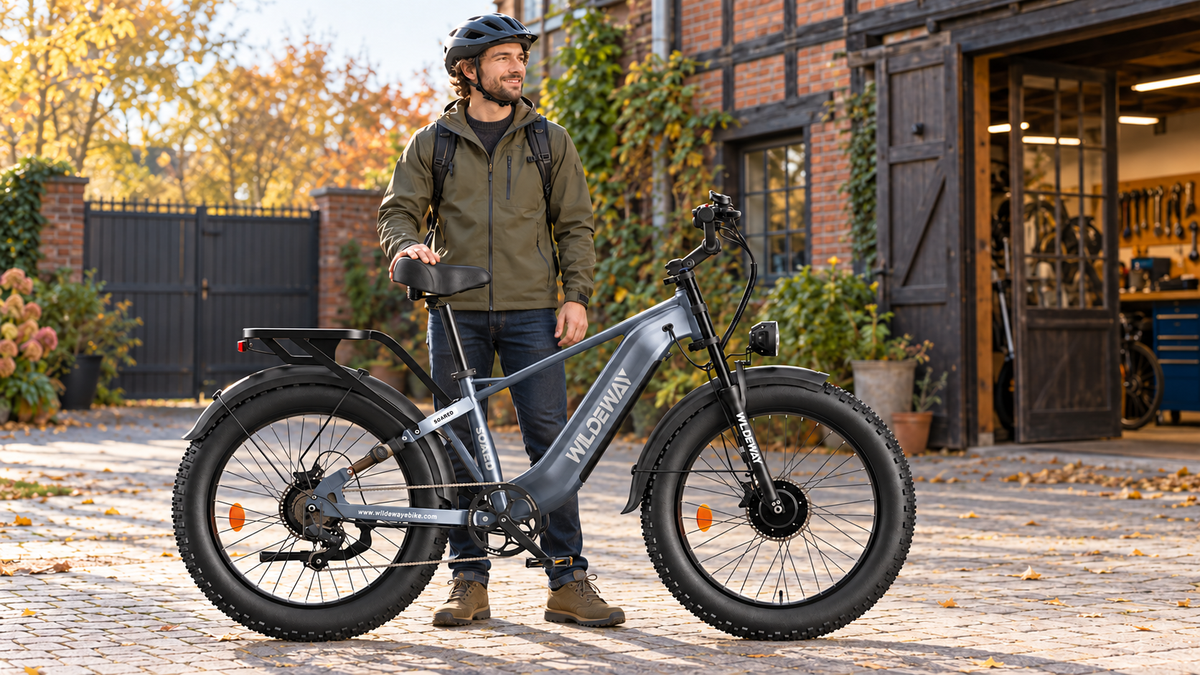
An e-bike test ride should establish whether you can mount comfortably, reach the controls, start and stop predictably, and manage the bicycle when the motor is off. Begin with setup and walking checks, then try gentle riding in an authorised area. Finish by checking the practical details of ownership before deciding.
For European buyers considering a full-size fat-tyre e-bike, these everyday questions matter as much as the specification sheet. Autumn also makes preparation worthwhile: bring the shoes, jacket and gloves you actually expect to use, and choose a dry session with good visibility.
This checklist uses the WILDEWAY SOARED Pro/Max as an example. It is a buying and familiarisation guide, not a report of an independent product test.
Agree where the test can take place
Before discussing saddle height, establish that the bicycle and venue are appropriate for the intended session. Tell the host your experience level, intended use and any concerns about supporting or manoeuvring a larger bicycle.
For SOARED, plan around authorised private-land or off-road use. Private ownership alone does not remove every legal requirement: ask about site access, local restrictions, insurance and the vehicle configuration allowed there. A publicly accessible car park is not automatically a suitable private test area.
EU Regulation 168/2013, Article 2(2)(h), defines an exemption for qualifying pedal-assist cycles based on continuous rated power and how assistance cuts out. A selectable speed limit or headline peak-power figure does not, by itself, prove that a particular bicycle qualifies. Do not assume an unlocked or dual-motor configuration is legal on public roads throughout Europe.
Ask the host to confirm the session rules and responsibilities before riding. The ADFC's test-ride guidance explains why these arrangements deserve attention. Keep children and other observers outside the riding area.
Bring a short list of personal requirements
Write down three things your bicycle must do comfortably. Examples include mounting in outdoor clothing, turning through a garage entrance and reaching the brake levers in gloves. A specific list makes it easier to compare bicycles without being distracted by acceleration.
Bring your usual helmet, closed shoes and suitable clothing. Avoid loose straps near the drivetrain. Keep your phone put away during riding and take notes after stopping.
In its advice on trying a bicycle before buying, ADFC recommends at least fifteen minutes and stresses the importance of correct setup. Treat that as a starting point, rather than proof that a short session predicts comfort on a long adventure.
Check fit before switching on assistance
Mounting and stopping position
With the system off and the bicycle supported, practise getting on and off. Check clearance around the frame and saddle without forcing an awkward movement. Repeat in the clothing you brought: what feels easy in summer shorts may feel different in a jacket and walking shoes.
Ask the host to set the saddle appropriately and explain the permitted adjustment limits. Do not lower it beyond a safe setting simply to make a large bicycle seem manageable. You need a pedalling position that works and a stopping technique you can repeat confidently.
Reach and control access
Check whether your shoulders feel relaxed and whether you can reach the brake levers without stretching your fingers or loosening your grip. Turn the handlebar gently while stationary with support. Your knees and clothing should stay clear of the controls.
A height recommendation is only a screening tool. People of the same height can have different leg lengths and reach. If you feel cramped, overextended or uncertain, pause for advice instead of assuming you will adapt after purchase.
Walk, turn and park the bicycle first
Push the bicycle along a clear, level section with assistance off. Try a broad turn and reposition it beside a wall without trapping yourself between the bicycle and the wall. Keep your fingers away from rotating wheels and brake discs.
Think about your real access route: a gate, a heavy garage door or a tight corner may demand more coordination than the open test area. Bring measurements rather than estimating from a photograph. Do not attempt a solo lifting demonstration if the bicycle feels beyond what you can comfortably manage.
ADFC's electric-bicycle buying guide highlights mounting, pushing, turning and storage as important considerations. A bicycle can feel pleasant under assistance while still being inconvenient to move at home.
Ask how the original kickstand operates and where it is suitable to use. Check that you can park and retrieve the bicycle without leaning it against fragile fittings. Keep parking and access questions on your buying checklist.
Build the riding check in manageable stages
Start with gentle, repeatable movements
Have the host explain the controls, selected assistance level, gearing and expected response before you move. Learn which lever operates each brake. Ask how to stop assistance and switch the system off.
Begin on a clear, level section at a manageable pace, following the host's instructions. Make a gentle start, continue straight and stop. Repeat only while you feel comfortable. Change unfamiliar settings while stationary, as ADFC advises.
Notice whether you can concentrate on the space ahead without repeatedly searching for a button. Tell the host immediately about unexpected drive behaviour; do not continue experimenting with controls you do not understand.
Assess braking without chasing a stopping-distance figure
On the agreed clear surface, get used to the brakes gradually. Aim for a controlled stop with room to spare. ADFC recommends approaching unfamiliar brakes cautiously rather than beginning with an emergency stop.
Pay attention to lever access, controllability and whether you can support the bicycle afterwards. Avoid recording an improvised braking distance as a product performance claim: surface, tyres, rider input and conditions would make comparisons unreliable.
Try broad turns before tighter manoeuvres
Once straightforward starts and stops feel comfortable, follow the host's suggested turning exercise. Keep generous space and reduce speed before turning. There is no need to demonstrate technical trail skills to make a buying decision.
Do not add wet leaves, steep descents or obstacles to make the session more realistic. If autumn conditions deteriorate, postpone the moving checks. For later outings, our wet-trail decision guide explains how to assess access and ground conditions.
What SOARED buyers should ask about
WILDEWAY lists SOARED Pro/Max with 26 × 4.0-inch tyres, full suspension, front and rear hub motors, hydraulic disc brakes and a removable battery. These are manufacturer-listed features, not independent findings from this article. Ask for the instructions and details for your exact variant.
| Area | Question to resolve |
|---|---|
| Full-size frame | Can I mount, stop and move this bicycle comfortably? |
| Full suspension | Who sets it up for me, and what routine servicing is required? |
| Controls and drive | Do I understand the fitted controls and their response? |
| Removable battery | Can the host demonstrate removal, locking and refitting? |
| Ownership support | What assembly help, replacement parts and local service options are available? |
Have battery handling demonstrated with the system off, following the manual. Resolve practical questions about keys and access without opening the battery casing or electrical connectors. A short demonstration cannot establish achievable range or long-term reliability.
Make a decision from your notes
Record what worked, what required adjustment and what remains unresolved. Use three simple outcomes: suitable as demonstrated, needs another setup check, or unsuitable for my requirements. A confident decision can include walking away from a bicycle that does not fit.
Before ordering online, clarify the current assembly, delivery, service and return conditions in writing. Do not assume that trying a bicycle permits unrestricted use before returning it. If the access route or fit remains uncertain, obtain measurements and further guidance first.
Explore the SOARED Pro/Max product page and send WILDEWAY your fit, handling and intended-use questions. The goal is a bicycle that suits both your authorised adventures and the ordinary moments before and after them.
Frequently asked questions
How long should an e-bike test ride last?
ADFC recommends at least fifteen minutes. Allow extra time for setup, questions and unpowered handling. A brief ride can reveal obvious fit problems, but it cannot establish long-distance comfort, battery range or reliability.
Can I test a SOARED Pro/Max on a public cycle path?
Do not assume so. This guide treats SOARED as a private-land/off-road model. Arrange an authorised setting and verify applicable access, vehicle and insurance requirements. A speed setting or the absence of traffic does not establish public-road legality.
Does being within the advertised height range guarantee a good fit?
No. Leg length, reach, flexibility and stopping technique differ between riders. Check mounting, saddle adjustment limits and access to the controls with the actual bicycle. Ask for help if you cannot stop and support it confidently.
Should I use maximum assistance during a test ride?
Start with the lowest suitable assistance and the host's instructions. Evaluate gentle starts, predictable stops and straightforward controls first. Change settings while stationary. A maximum-power demonstration is unnecessary for assessing whether the bicycle suits you.
What if I cannot arrange a test ride before buying online?
Ask WILDEWAY for current geometry, adjustment limits, configuration details and a walkthrough of the exact model. Measure your access route and clarify assembly, service and return conditions in writing. Similar bicycles can provide context but cannot confirm this model's fit.
Can two family members share one SOARED?
Only if each person independently fits the bicycle and can handle it confidently within its adjustment limits. Record separate settings and reassess before use. A successful test by one rider does not establish suitability for the other.
Sources
Checked on 17 October 2026.
- WILDEWAY: SOARED Pro/Max product details — manufacturer specifications.
- ADFC: Kein Fahrradkauf ohne Probefahrt — setup, duration and progressive familiarisation.
- ADFC: Elektrorad-Kaufberatung — controls, ergonomics and everyday handling.
- ADFC: Fahrrad-Probefahrt ohne Risiko — test-ride arrangements.
- EUR-Lex: Regulation (EU) 168/2013 — Article 2(2)(h).
Partager:
E-Bike for Food Delivery: Plan Your Shift in Europe
E-Bike Puncture: Repair or Arrange Recovery in Europe?