
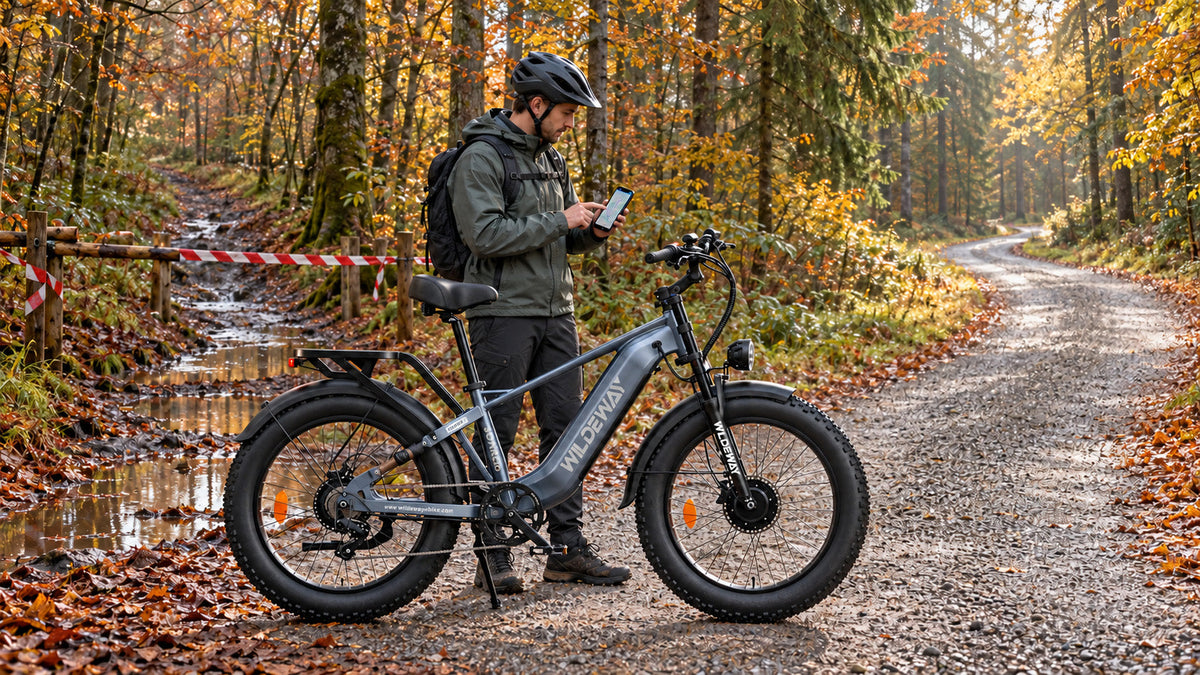
Wet Trail E-Bike Etiquette: Ride, Reroute or Wait?
Do not ride a wet trail simply because your e-bike has fat tyres, full suspension or dual motors. Ride only when the route is legally open and the surface is firm enough to resist damage. Reroute onto a permitted gravel or hard-surfaced track when the natural trail is saturated, and postpone the trip when closures, deep mud or uncertain access make responsible riding impossible.
Autumn rain can transform a familiar forest route within hours. A firm trail on Friday may become soft, rutted and difficult to use by Saturday morning.
For riders of substantial all-terrain e-bikes such as the WILDEWAY SOARED Pro/Max, the important question is not only whether the bicycle can cross the terrain.
The better question is:
Should this route be ridden in its current condition?
Capability Is Not the Same as Permission
The SOARED platform combines 26×4.0-inch tyres, full suspension, dual hub motors and a listed combined torque figure of 136Nm. WILDEWAY also lists the bicycle at 48.3kg.
These characteristics describe its hardware. They do not give the rider permission to use every forest path, protected area, walking route or public cycleway.
They also do not make a soft trail immune to damage.
A heavy, powerful e-bike can continue moving where a lighter bicycle might lose momentum. That makes rider restraint more important—not less important.
Before evaluating mud, grip or tyre pressure, establish whether the route is open to the exact type and configuration of bicycle you intend to use.
Start With the Local Access Rules
European forest access is not governed by one universal rule.
In Germany, Section 14 of the Federal Forest Act states that cycling in forests is permitted on roads and paths, while the federal states regulate the details and may impose restrictions for forest protection, visitor safety or the prevention of substantial damage. That general provision does not confirm that every trail—or every powerful e-bike configuration—is permitted. Einzelnorm
Rules can be very different across borders. Austria’s responsible ministry states that cycling and mountain biking in forests, including on forest roads, require the consent of the forest owner or road maintainer. Permission may be communicated through signs or designated routes. bmluk.gv.at
Therefore, check:
- National and regional regulations.
- Trailhead signs.
- Seasonal closures.
- Landowner or bike-park conditions.
- Whether e-bikes are permitted.
- Whether the exact vehicle classification is permitted.
- Temporary closures following storms or forestry work.
An online route appearing on a map is not proof of legal access.
The Ride, Reroute or Wait Test
Use this table before entering the trail:
| Trail condition | Recommended decision | Reason |
|---|---|---|
| Official closure or e-bikes prohibited | Wait or choose another area | A different bicycle setup does not override a closure |
| Continuous soft mud or tyres sinking deeply | Wait | Riding is likely to deepen ruts and damage the surface |
| Water flowing along the trail | Wait or reroute | The surface and drainage may already be under stress |
| Firm, open gravel forest road after rain | Ride cautiously | A durable surface may remain usable if access is permitted |
| Isolated puddle on an otherwise firm, open trail | Proceed slowly if safe | Do not create a new line around the puddle |
| Access or surface condition uncertain | Reroute | A confirmed, durable alternative is the responsible choice |
This is a practical decision framework, not a substitute for instructions from the land manager.
1. Check Conditions Before Leaving Home
A responsible ride begins before the bicycle leaves the garage.
Check:
- Recent rainfall.
- Forecast rain during the ride.
- Local trail-status pages.
- Bike-park or land-manager notices.
- Forestry-work alerts.
- Flood or storm warnings.
- Sunrise and sunset times.
- Whether a firm alternative route is available.
Do not rely only on the weather at your home. A wooded hillside, valley or higher-elevation route may have received more rain and may dry more slowly.
If the route operator provides an open-or-closed status, follow it even when your own visual impression seems different.
2. Assess the Surface Without Riding Into It
At the trailhead, stop on a durable surface.
Look for:
- Standing water across long sections.
- Freshly formed ruts.
- Tyre tracks filled with water.
- Soft trail edges.
- Water running down the centre of the route.
- Footprints or hoof marks sinking deeply.
- Damaged drainage channels.
- Temporary barriers or closure notices.
Do not ride several hundred metres into a soft route merely to “test” whether it improves.
If the first section is saturated and the surrounding ground is equally wet, use your alternative route or postpone the ride.
3. Distinguish a Wet Surface From a Saturated Trail
Not every damp route must be avoided.
A compact gravel road can remain firm after rain, while a narrow natural trail containing clay, loam or poorly drained soil may deform under much lighter use.
A route may be suitable when:
- The surface remains firm under normal walking pressure.
- Tyres leave little or no visible rut.
- Water is draining across rather than along the track.
- The route is officially open.
- There is enough width to meet other users safely.
- Continued rainfall is not expected to worsen conditions.
Postpone when the ground moves, smears or displaces easily.
IMBA’s responsible-riding guidance advises choosing appropriate trails or dirt roads in wet conditions because riding on soft ground can accelerate erosion. imba.com
4. Do Not Create a Dry-Line Bypass
A common mistake is avoiding a puddle by riding onto vegetation or the soft trail edge.
Repeated bypasses can widen the route and create a second line. That may damage plants, compact new ground and make future drainage more difficult.
If an isolated puddle appears on an otherwise firm, permitted and open route:
- Slow down before reaching it.
- Check that the centre line is safe.
- Keep the bicycle controlled and upright.
- Pass through without sudden acceleration.
- Do not skid or spin the tyres.
- Do not ride around it through vegetation.
If the puddle is deep, conceals hazards or forms part of continuous saturation, turn around instead.
5. Use Assistance Smoothly
The SOARED product page lists two 68Nm hub motors and five pedal-assistance levels. That available assistance should be managed carefully on low-grip terrain.
Abrupt acceleration can cause wheelspin, particularly on wet roots, polished stones, wooden surfaces or soft soil.
For a permitted route that remains suitable to ride:
- Select a lower assistance level before the slippery section.
- Apply power progressively.
- Keep steering inputs smooth.
- Avoid accelerating hard while turning.
- Brake before the obstacle rather than sharply on it.
- Leave additional distance from other trail users.
- Walk the bicycle when the surface exceeds your ability.
Full suspension can help the wheels follow uneven terrain, but it cannot guarantee grip.
Similarly, 26×4.0-inch tyres do not make wet roots, leaves or mud automatically safe.
6. Leave Space for Walkers, Horses and Other Riders
Many forest roads and recreational routes are shared.
Approach other users slowly and make your presence known without startling them. If the route is too narrow for a comfortable pass, stop on a durable part of the trail and allow space.
Good practice includes:
- Reducing speed before reaching people or animals.
- Giving way according to posted rules.
- Asking before passing.
- Avoiding sudden motor noise or acceleration.
- Keeping groups small enough to manage.
- Stopping away from blind corners.
- Moving completely clear when checking a map.
Leave No Trace guidance for multi-use trails recommends yielding appropriately, staying alert, stepping aside on a durable surface when stationary and following the route’s specific rules. Leave No Trace - LNT.org
7. Do Not Treat “Off-Road” as a Legal Classification
WILDEWAY markets the SOARED Pro/Max as an off-road e-bike and lists a dual-motor system, throttle assistance and adjustable settings.
Those product characteristics do not establish that every operating configuration qualifies as a standard public-road EPAC throughout Europe.
Before using the SOARED on:
- Public roads.
- Cycle paths.
- Forest roads.
- Shared recreational routes.
- National-park routes.
- Privately managed trails.
confirm both the route permission and the vehicle classification.
An unlocked configuration should be reserved for an environment where that specific configuration is permitted, such as appropriately authorised private land or a suitable closed course. “Private land” still requires the landowner’s permission.
8. Carry a Genuine Plan B
A responsible autumn route should include an alternative that does not depend on the same natural trail surface.
Useful alternatives may include:
- A permitted compact gravel road.
- A surfaced cycle route suitable for the legal bike configuration.
- A shorter loop within an authorised off-road area.
- A return route to the trailhead.
- Postponing the ride and completing maintenance at home.
Save the alternative route offline where possible. Forest coverage can be unreliable, and a weather-related diversion may take longer than expected.
If rerouting may extend the ride towards dusk, consult WILDEWAY’s low-light e-bike riding guide before departure.
9. Consider the Bike’s Weight Before Entering Difficult Ground
At 48.3kg, the SOARED Pro/Max is a substantial bicycle.
If the tyres sink into deep mud or the route becomes blocked, lifting, turning or pushing the bicycle can demand considerable effort.
Before entering a remote section, ask:
- Can I turn the bicycle around here?
- Could I push it back uphill without motor assistance?
- Is there space to stop without blocking the route?
- Is mobile coverage available?
- Does someone know my route?
- Can I manage the bicycle if the battery or drive system becomes unavailable?
Motor assistance should never be the only plan for leaving difficult terrain.
10. Clean Without Spreading Mud or Damaging Components
After a permitted wet-weather ride, remove mud before it dries around the drivetrain, suspension and brakes.
Use gentle cleaning methods:
- Remove loose dirt with a soft brush.
- Use a damp cloth or low-pressure water flow.
- Clean the drivetrain separately.
- Keep lubricant away from rotors and pads.
- Wipe suspension surfaces.
- Inspect tyres for embedded debris.
- Dry the bicycle before storage.
- Check for unusual play or damage.
Do not use a high-pressure washer on electrical, bearing or suspension areas.
Cleaning after the ride does not make an unsuitable trail choice acceptable, but it helps keep the bicycle ready for its next permitted adventure.
A Five-Minute Trailhead Decision
Before starting, ask these five questions:
- Is this route open to my exact bicycle configuration?
- Is the surface firm enough to avoid visible damage?
- Can I ride without widening the route or entering vegetation?
- Can I meet and pass other users safely?
- Do I have a durable alternative if conditions deteriorate?
If any answer is uncertain, reroute or postpone.
Final Thoughts
A capable all-terrain e-bike can expand where you explore, but responsible access depends on judgement rather than motor power.
For autumn riding, the best approach is simple:
Check permission → assess the surface → choose ride, reroute or wait → ride smoothly → leave the trail as you found it.
The WILDEWAY SOARED Pro/Max combines 26×4.0-inch tyres, full suspension and a dual-motor platform for demanding authorised environments. Those features should be paired with careful route selection, conservative control and respect for local rules.
Explore the WILDEWAY SOARED Pro/Max and plan its use around permitted terrain—not simply the most difficult line the bicycle might be able to cross.
Frequently Asked Questions
Should I ride an e-bike on a muddy trail?
Avoid riding when the trail is continuously soft, saturated, officially closed or developing deep ruts. Choose a firm, permitted alternative or postpone the ride.
Do fat tyres prevent trail damage?
No. Wide tyres do not make a saturated surface immune to deformation or erosion. Trail condition, soil, drainage, rider behaviour and total system weight all matter.
Should I ride around a puddle?
Do not create a new line through vegetation. On an otherwise firm, open trail, pass an isolated puddle slowly through the established route only when it is safe. Turn around if the section is deeply flooded or continuously soft.
Can I ride the SOARED Pro/Max on any forest road?
No. Access rules differ by country, region, landowner and bicycle classification. Check signs, local law, land-manager instructions and the exact SOARED configuration.
Is an unlocked SOARED configuration legal on European public roads?
Do not assume so. A dual-motor or unlockable configuration is not automatically road-legal. Verify the exact vehicle classification and reserve non-permitted configurations for suitably authorised environments.
What is the best alternative after heavy rain?
Choose an officially open compact gravel or surfaced route that remains firm, or postpone the ride. A proper Plan B should not depend on another soft natural trail.
Share:
Low-Light E-Bike Riding in Europe: Autumn Safety Guide
E-Bike for Food Delivery: Plan Your Shift in Europe