
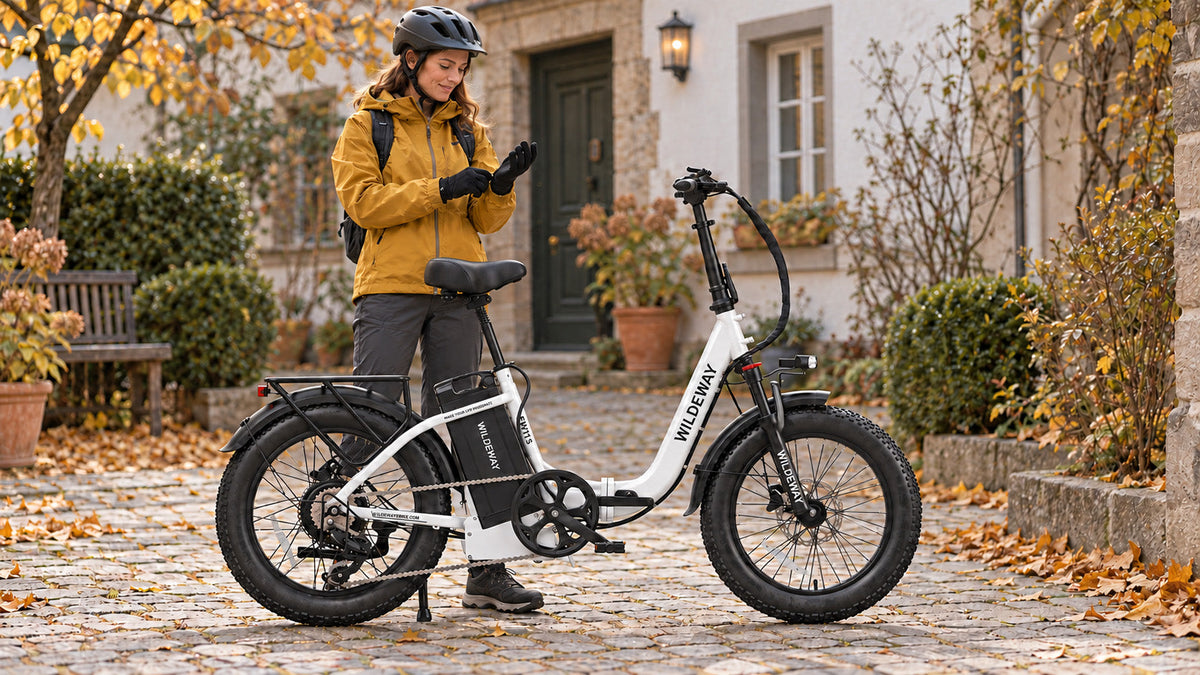
For autumn e-bike rides, wear adjustable layers, gloves that let you operate every control, and trousers and footwear that stay clear of the drivetrain. Add rain protection when needed, then check the whole outfit on the stationary bike before leaving. The right clothing should let you brake, look behind, mount and dismount comfortably as conditions change.
Across Germany and the wider EU, a cold morning can become a mild afternoon, while a short café stop can leave yesterday’s ideal jacket feeling inadequate. This guide focuses on those practical clothing decisions. It uses the WILDEWAY FW11S 3.0 Pro, a step-through folding e-bike with 20 x 3.0-inch tyres and front suspension, as an example. Clothing advice does not establish vehicle legality: confirm your exact bicycle configuration and local road and route requirements separately.
Build an outfit around the journey
Start with three questions: how long will you be outside, how much effort will you make, and what happens if you stop? A short errand with sheltered destinations needs a different plan from a countryside outing with a long exposed return. Check the forecast for your return time, including wind and rain, rather than dressing only for the moment you open the door.
There is no universal outfit for a particular temperature. Assistance level, pace, personal comfort and exposure all matter. Try your existing clothes on a short familiar route before buying a complete winter wardrobe. Note what became damp, restrictive or cold, then change that part of the system.
| Journey | Useful starting point | Check before leaving |
|---|---|---|
| Short town errand | Comfortable everyday layers and a wind-resistant outer layer | Trouser hems, shoe grip and freedom to turn your head |
| Changeable commute | Removable insulation with packable rain protection | Room for the shell over work clothes and a dry return option |
| Longer leisure ride | Moisture-managing layers and a protected spare layer | Glove control, comfort during stops and space to carry removed clothing |
Use layers you can adjust while stopped
The German cycling association ADFC recommends several thin layers for autumn’s changing conditions, with wind protection when it becomes cold. Think of your outfit as separate jobs: a comfortable layer against the skin, an optional insulating layer, and an outer layer selected for the weather.
Our practical approach is to test the combination before a longer ride. Sit in your normal riding position and reach forward. The jacket should not pull tightly across your shoulders or expose your lower back. Check that the sleeves still cover your wrists without interfering with your gloves. Bend each knee through a full pedal stroke to find tight seams or fabric bunching.
Stop somewhere safe to change layers. Open a vent or remove insulation before you become uncomfortably hot, and add protection before a lengthy stop or exposed return. Keep the layer you remove inside a secured bag; draping it over the handlebars or rack creates an avoidable loose item.
Choose gloves by how they work on your bike
Warmth is only part of the glove decision. With the system switched off and the bicycle securely supported, put on your intended gloves and take your normal grip. Operate each brake lever independently, use the gear shifter, and find the assistance controls without repeatedly looking down. Make sure the glove material cannot catch on a control.
A bulky glove that forces you to release most of your grip to reach the brake is a poor match for that setup. Equally, a thin glove that leaves your fingers painfully cold is not a useful compromise. The ADFC’s cold-weather clothing guidance highlights the connection between cold fingers and difficulty braking promptly. Choose a fit that preserves movement and assess it with the actual controls you will use.
Before a longer outing, repeat the control test after a short local ride. If your hands become numb or you cannot use the levers reliably, stop in a safe place and change the plan. A touchscreen-compatible fingertip is convenient when stationary, but it is less important than dependable braking and steering.
Keep hems, scarves and straps away from moving parts
A step-through frame makes access easier for many riders, but it does not protect loose clothing from the chain or wheels. Secure wide trouser cuffs with suitable ankle bands or choose a tapered hem. Tuck shoelace loops away and check for dangling coat belts, drawcords and bag straps. A scarf should be contained inside the jacket rather than trailing beside the frame.
The UK Department for Transport’s Highway Code, Rule 59, advises against clothing that can catch in a chain or wheel or obscure lights. This is useful safety guidance; it is not a statement of German or EU law.
For the FW11S Pro, inspect clothing clearance around the crank, rear wheel, rack and battery behind the seat tube. Its folding hinge also deserves a clothing check when you fold or unfold the bike. Follow the manual, keep fabric clear of closing joints, and confirm the frame and stem latches are secured before riding. Never adjust a cuff near a moving wheel.
Check rainwear in your riding position
Try the rain jacket over the layers you actually expect to wear. Reach both brake levers, look over each shoulder and practise getting on and off the stationary bike. Check that cuffs overlap sensibly with gloves and that the trouser bottoms cannot touch the chainring. Rainwear should allow movement without leaving excessive loose fabric.
A hood that narrows your peripheral vision or prevents a shoulder check needs adjustment or a different solution. Do not assume it works simply because it fits over a helmet. The ADFC’s autumn clothing article also notes that a poncho can catch wind like a sail. Assess its fit and behaviour carefully rather than treating all waterproof garments as interchangeable.
For a commute, rehearse putting the shell on before you need it. Choose a safe stopping place away from traffic, leave enough time, and avoid balancing on one leg beside the carriageway while wrestling with overtrousers. Practising at home makes a sudden shower less disruptive.
Match shoes and headwear to secure control
Your footwear needs to work when you are walking as well as pedalling. Check that the sole sits securely on the original pedals and that you can put a foot down without a loose overshoe catching. Avoid experimenting with unfamiliar shoes on the day of a long outing. If you add thicker socks, check that the shoe remains comfortable rather than squeezing your foot.
A thin helmet-compatible liner may be useful, but reassess the helmet’s fit whenever you add something underneath. Follow its manufacturer’s instructions. The straps should remain correctly adjusted and the helmet should stay stable when you move your head. Do not compensate for unsuitable bulky headwear by leaving the fastening loose.
Check glasses with the complete outfit, too. Breathe normally, look sideways and confirm that the collar or face covering does not push them out of position. If fogging or rain prevents a clear view, stop safely to resolve it.
Plan for the return and complete a two-minute check
Pack removed clothing and a small dry spare in a properly secured bag, clear of wheels, lights and controls. Check that the loaded bag does not obstruct mounting. Before setting off, look at the bicycle from the front and rear: a long jacket or hanging layer should not hide its lamps. Reflective details can supplement appropriate lighting, but do not replace it.
Use this final routine with the bike stationary:
- Reach and squeeze both brake levers while wearing your gloves.
- Turn your head comfortably in both directions.
- Secure every cuff, lace, cord and strap.
- Mount and dismount without snagging clothing.
- Confirm that the lights remain visible and spare layers are secured.
For surface and weather decisions beyond clothing, see our first-frost riding checklist. Clothing cannot make an icy route safe.
Frequently asked questions
Do I need specialist clothing for a short e-bike commute?
Not necessarily. Comfortable everyday clothes can work if they allow movement, suit the weather and stay clear of moving parts. Longer or more exposed rides may justify clothing designed for moisture management and weather protection.
How many layers should I wear?
Use a combination you can adjust for your effort, the forecast and planned stops. Start with a comfortable base, add insulation as needed, and choose an outer layer for wind or rain. Test it on a short ride.
Can I use ordinary winter gloves?
Only if they let you grip securely and operate both brakes, gears and assistance controls reliably. Test them on your stationary bike first. Warmth alone does not establish suitability.
Can I wear a long coat on a step-through e-bike?
Check the complete coat in your riding position. Secure belts and loose fabric, keep it clear of wheels and the drivetrain, and ensure it does not obscure lights. A low frame does not remove entanglement risks.
What should I do if my hands become too cold to brake properly?
Stop safely and warm up somewhere suitable. Change gloves or arrange another way home if necessary. Continue only when you can operate the bicycle reliably and conditions are suitable.
Dress for comfort that preserves control
Build your autumn outfit around adjustment, secure fit and a practical control check. For a compact everyday platform, explore the FW11S Pro’s step-through folding design and verify its fit for your own clothing and journey. Its front suspension, rear rack and mudguards are useful features; a thoughtful outfit completes the preparation.
Sources reviewed 27 October 2026: ADFC guidance linked above and the UK Highway Code. Product construction checked against the current WILDEWAY EU product page and official photographs. Practical fitting routines are editorial suggestions, not reported product tests.
Deel:
Cold-Weather E-Bike Riding: The First-Frost Checklist