
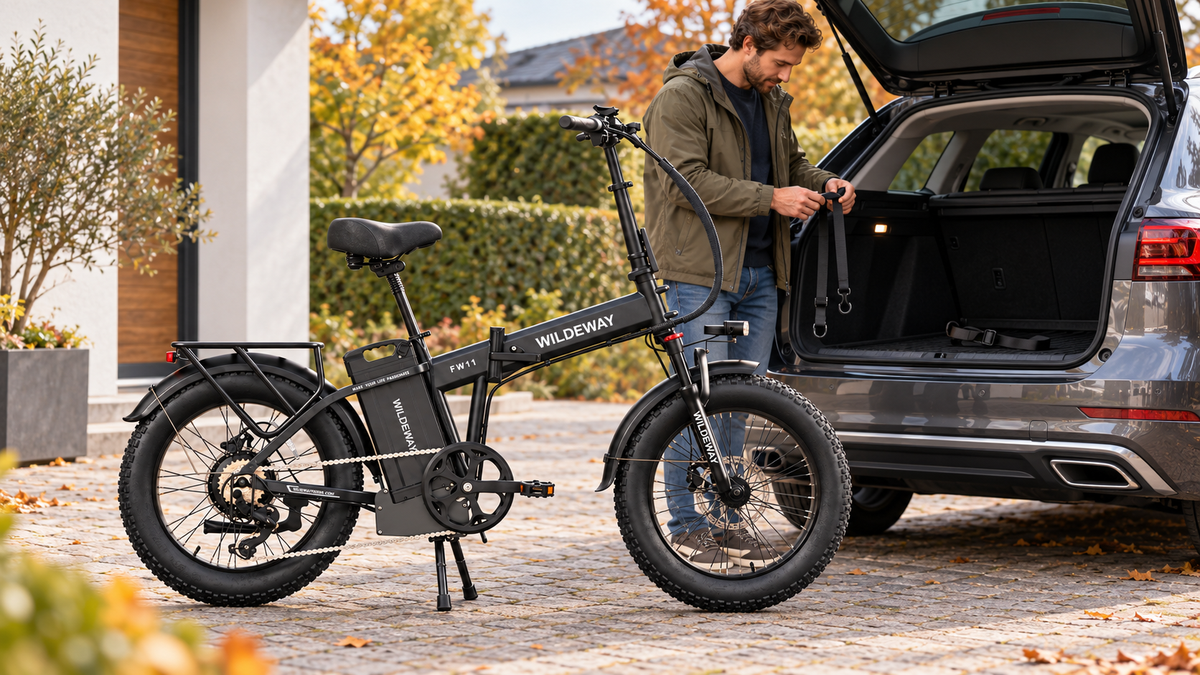
Yes—a folding e-bike can travel safely inside a car boot when it fits without forcing the hatch, is protected from damaging contact and is secured to the vehicle’s load anchors. Measure first, remove only the parts the manufacturer permits, keep the battery and loose accessories restrained, and make sure the folded bike cannot slide, roll or enter the passenger area during hard braking.
This guide uses the WILDEWAY FW11 Pro as a practical example. It is a step-over folding e-bike with 20 × 3.0-inch tyres, front suspension, a rear hub motor, hydraulic disc brakes and a removable battery. Those features influence where you support the bike and what must remain free from pressure.
Start with measurements, not assumptions
“Folding” does not automatically mean “fits every car”. Boot openings can be narrower than the space behind them, while sloping rear glass can reduce usable height. Before a trip, measure the actual folded bicycle in the configuration described in its manual, then measure three parts of the car:
- the narrowest width and height of the boot opening;
- the usable floor length with the required seats in their travel position;
- the height available beneath the closed hatch.
Allow space for padding and straps. The hatch should close normally without pressing on the handlebar, display, saddle, battery or frame. Check the car handbook for payload and approved load-anchor use, and remember that passengers, luggage, bicycle and accessories all contribute to the vehicle load.
If the bike does not fit comfortably, use a carrier approved for the vehicle and for the combined load instead of forcing it into the boot. ADAC’s current guidance says carrier load limits, vehicle limits and installation instructions must be followed; it also notes that external bicycle-transport rules differ between European countries.
Prepare the FW11 Pro before folding
Work on level ground with the car parked, the parking brake applied and the bicycle switched off. Clear the boot first so that you are not balancing the bike while rearranging bags.
- Remove loose accessories. Take off bottles, pumps, detachable bags, phone holders and anything else that could become a projectile. Keep keys where they cannot scratch the frame or short against a terminal.
- Decide what to do with the battery. The FW11 Pro product page describes its battery as removable. Follow the bicycle manual for removal and transport. If removed, protect the contacts, keep the battery dry and place it in a stable, padded position where it cannot move. Never leave it loose in the passenger compartment.
- Lower or fold only approved components. Use the manufacturer’s sequence for the frame hinge, handlebar stem and pedals. Do not force a latch or use a cable as a handle.
- Check the contact points. The display, brake levers, brake hoses, rear derailleur, disc rotors and fork stanchions should not carry the bike’s weight.
ADAC also recommends removing parts that are not permanently attached before transporting a bicycle and recommends battery removal for pedelecs on external carriers. Inside a car, the manufacturer’s instructions remain decisive: a removed battery still needs its own secure, protected place.
A safe car-boot loading sequence
1. Protect the car and bicycle
Use a clean, non-slip boot mat and soft blankets or purpose-made pads. Keep dirty tyres separate from upholstery, but do not wrap the entire bicycle in a loose sheet that could hide an unsecured component. A small piece of padding between hard contact points is more useful than bulky layers that compress and loosen during the drive.
2. Plan the lift
A compact e-bike can still be awkward because the motor, battery and reinforced frame concentrate weight. Use two adults when the lift feels uncertain. Agree who controls the handlebar end and who controls the rear of the frame, keep fingers away from the folding hinge, and lift with a stable stance. Do not lift by the saddle alone, the rack, a cable or the display.
3. Choose the resting side carefully
There is no universal “correct side” for every bicycle and car. Choose the position that keeps pressure away from the rear derailleur, disc rotors, controls and battery interface. The FW11 Pro has a rear hub motor and hydraulic disc brakes, so avoid using the motor cable, brake hose or rotor as a support point. Do not squeeze a brake lever while a wheel or brake component is displaced.
4. Restrain the frame and stop wheel movement
Use the car’s approved load anchors and suitable straps. Soft loops can help keep buckles away from paint. Restrain a strong frame area without crushing cables, and stop the bicycle moving forward, backward or sideways. A second restraint can control wheel or folded-component movement, but straps should not run over spokes, brake hoses, fork stanchions or sharp edges.
Push and pull the secured bike firmly before closing the hatch. It should not roll, tip or gain momentum. Keep heavy items low, separate other luggage, and do not rely on the rear seatback or a pile of bags as the only restraint.
5. Keep the passenger area clear
Nothing should project between occupants or interfere with seat belts, airbags, mirrors or the driver’s view. If a folded bike cannot remain fully within the cargo area, change the plan. Never transport a passenger beside an inadequately restrained bicycle.
What the law requires in Germany—and what changes abroad
For trips in Germany, Section 22(1) of the German Road Traffic Regulations (StVO) requires loads and load-securing equipment to be stored and secured so that they do not slip, fall over, roll, fall off or create avoidable noise even under emergency braking or sudden evasive movement. A bicycle inside the boot is still a load.
The European Commission’s road-safety guidance likewise explains that proper load securing helps prevent injury and damage. However, detailed road rules, enforcement and requirements for external carriers are national. ADAC highlights special warning-panel rules for externally carried bicycles in countries including Italy, Spain and Portugal. Check the official rules for every country on your route, especially if any part of the load sits outside the vehicle.
This article is practical guidance, not a substitute for the bicycle manual, car handbook, carrier instructions or national law.
Five checks after unloading
Transport can shift adjustments even when nothing looks damaged. Before riding away:
- confirm the main frame hinge and handlebar-stem latch are fully closed and secured;
- check that the battery is correctly seated and locked, if it was removed;
- spin both wheels and look for rotor rub, a displaced mudguard or a trapped cable;
- test both brakes at walking pace in a traffic-free area;
- check tyre condition, lights, pedals and the kickstand before joining any route.
If a latch will not close normally, a cable is pinched, a rotor is bent or a warning appears on the display, do not improvise a roadside fix. Arrange inspection by a qualified technician. The WILDEWAY e-bike test-ride checklist provides a useful low-speed handling routine, while the puncture and recovery guide can help you plan for a tyre problem away from home.
Why the FW11 Pro suits this use case
The FW11 Pro combines a step-over folding frame with compact 20 × 3.0-inch wheels. Its front suspension, rear hub motor, removable battery, rack, mudguards and lighting make it a practical example of why transport planning involves more than the frame hinge. Every part still needs clearance and support.
Before buying around a specific car, compare the current product details with your measured boot opening and your own lifting ability. Do not treat a published dimension or another owner’s vehicle as proof of fit. Explore the current FW11 Pro specifications and colour options, then test the loading sequence at home before a longer autumn weekend trip.
Frequently asked questions
Can I transport a folding e-bike loose in the boot?
No. Folding reduces size but does not stop the bicycle moving during emergency braking or an evasive manoeuvre. Use approved load anchors and suitable restraints.
Should I remove the FW11 Pro battery for car transport?
The battery is removable, but follow the current bicycle manual. If removed, protect its contacts and secure it separately so it cannot slide, receive an impact or contact loose metal objects.
Which side should a folded e-bike rest on?
Use the side and support points specified by the manufacturer. Avoid loading the rear derailleur, disc rotors, brake hoses, display, fork stanchions or battery connection.
Can I hold the folded bike with ordinary luggage?
No. Bags may shift or compress. Restrain the bicycle independently to suitable vehicle load anchors, then secure the remaining luggage separately.
Do the same transport rules apply across Europe?
No. Basic load security is essential everywhere, but national rules differ—especially for external carriers, warning panels and overhanging loads. Check official rules for each country travelled.
What should I inspect before riding after transport?
Check both folding latches, battery seating, cables, tyres, pedals, kickstand, lights, wheel rotation and brakes. Test braking and steering at low speed in a safe area before entering traffic.
Sources
- WILDEWAY FW11 Pro product page — product configuration and current manufacturer specifications.
- German StVO §22: Load securing — official German law.
- European Commission: Cargo securing and abnormal loads — general road-safety principle.
- ADAC: Transporting bicycles by car — carrier limits and cross-border considerations, updated 20 March 2026.
- ADAC Hessen-Thüringen: Bicycle transport guidance — loose-part and battery guidance.
Sources accessed 22 October 2026.
Condividere:
E-Bike Service Appointment: What to Bring and Ask