
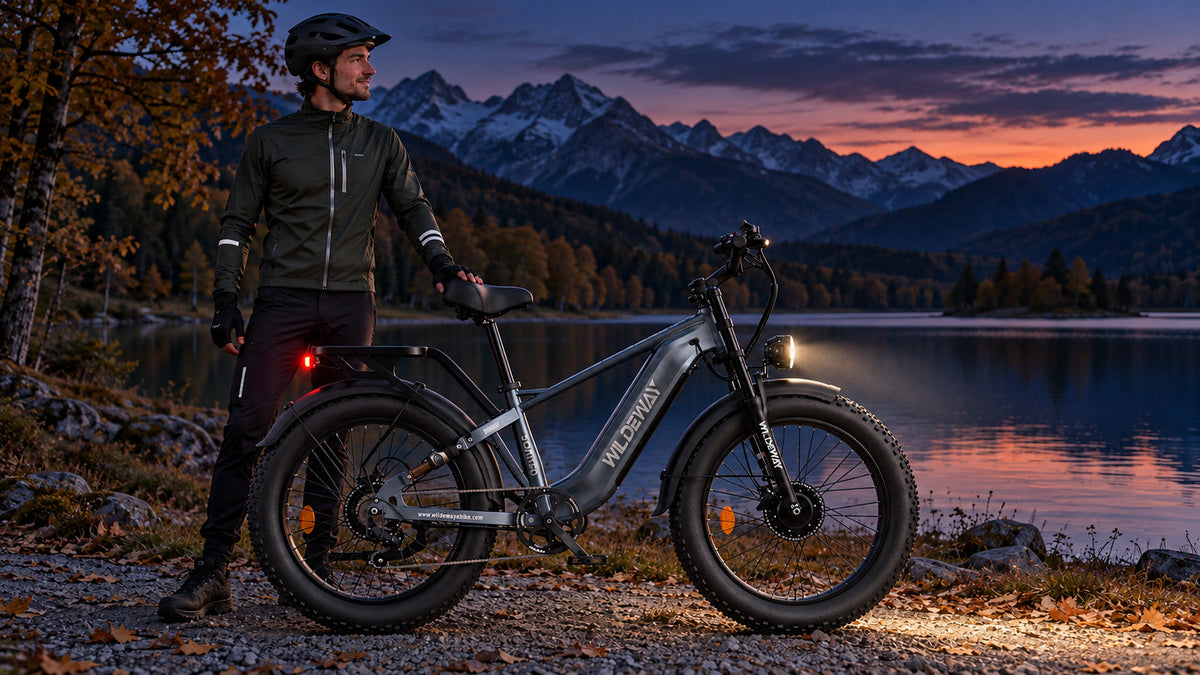
Low-Light E-Bike Riding in Europe: An Autumn Safety Guide
The safest way to ride an e-bike in low light is to combine effective front and rear lighting, reflective details, a route with predictable surfaces, reduced speed and a battery plan that accounts for colder weather and longer use of the lights. Being able to see the road is important, but being seen by other road users is equally important.
Autumn changes the rhythm of cycling across Europe. The sun sets earlier, mornings begin darker and rain, fog or fallen leaves can reduce contrast on the road. A route that feels simple in July may require more preparation in late September or October.
The WILDEWAY SOARED Pro and SOARED Max are designed as substantial all-terrain e-bikes with integrated lighting and wide 26×4.0-inch tyres. These features can support low-light commuting and permitted outdoor rides, but no bicycle specification removes the need for careful route planning and local-rule awareness.
Why Low-Light Riding Needs a Different Routine
Visibility is not only about darkness. A rider can be difficult to see during:
- Dawn and dusk.
- Heavy rain.
- Fog and mist.
- Dense tree cover.
- Narrow streets with parked vehicles.
- Backlit urban roads.
- Routes with wet or reflective surfaces.
- Areas where lights and signs blend into the background.
The European Commission advises cyclists to use lights at night and in poor weather, wear reflective or brightly coloured clothing and ensure that mudguards do not reduce the visibility of lights and reflectors. Mobility & Transport - Road Safety
EU-OSHA also identifies poor visibility, darkness, rain, snow and road hazards as specific risks for people who cycle for commuting or work. EU-OSHA E-Guides
The practical lesson is simple: low-light riding should be planned before you leave, not improvised after the sky has already become dark.
1. Check the Light System Before Every Ride
Make lighting part of your pre-ride check.
Confirm that:
- The front light turns on immediately.
- The rear light is visible from a reasonable distance.
- The brake-light function works where fitted.
- Turn signals operate correctly where fitted.
- The lenses are clean.
- Mudguards, luggage or clothing do not block the beams.
- The light angle does not shine directly into approaching riders’ eyes.
- The battery level is sufficient for the entire ride.
The SOARED product page lists a 600-lumen front LED light with adjustable angle, plus a rear light with braking indication and turn signals. The FW11 Pro and FW11S Pro product pages also list integrated front lighting and rear lighting features. These are verified product claims, not a substitute for checking the exact delivered configuration and local equipment rules. WILDEWAY EU
A light that works at home but becomes obscured by a rack bag or mudguard is not a complete lighting setup.
2. See the Surface, Not Only the Road Ahead
A powerful front light should help you identify the surface several metres ahead, not simply make the bicycle visible to others.
On mixed terrain, look for:
- Potholes.
- Broken paving.
- Loose gravel.
- Wet leaves.
- Mud.
- Metal covers.
- Drainage channels.
- Raised roots.
- Deep ruts.
- Standing water.
On permitted private-land or off-road routes, a broader beam can make uneven ground easier to interpret. On public roads and cycle paths, lighting should also be considerate to oncoming riders and pedestrians.
Adjust the beam so that it illuminates the route without creating unnecessary glare. If you use an additional helmet or handlebar light, make sure the combination does not create confusing or overly bright flashes for others.
3. Make Yourself Visible from the Side
Many riders focus on front and rear lights but forget that other road users may approach from the side.
Visibility can improve when you add:
- Reflective ankle bands.
- Reflective details on a jacket or bag.
- Bright outer layers.
- Reflective elements on panniers.
- Wheel or spoke reflectors where permitted.
- A light-coloured helmet cover.
- Reflective strips on gloves or sleeves.
Side visibility can be particularly useful at junctions, roundabouts and entrances to shared paths.
The European Commission specifically recommends reflective clothing or accessories and notes that reflectors can be visible from the front and rear. Mobility & Transport - Road Safety
Wear bright colours in daylight and use reflective elements to become more visible when illuminated by headlights after dark.
4. Wear Clothing That Does Not Create New Hazards
Autumn layers can improve comfort, but loose clothing can also interfere with the bicycle.
Avoid garments that may:
- Catch in the chain.
- Contact the rear wheel.
- Cover the rear light.
- Restrict your shoulder movement.
- Obstruct your peripheral vision.
- Reduce your ability to operate the brake levers.
A practical low-light outfit may include:
- A breathable waterproof jacket.
- Full-finger gloves with good grip.
- Trousers that stay clear of the drivetrain.
- A helmet that fits securely.
- A reflective vest, harness or jacket detail.
- Clear or low-light cycling glasses.
The UK Highway Code also advises cyclists to avoid clothing that can become tangled in a wheel or chain and notes that light-coloured and reflective accessories can improve visibility in poor light. GOV.UK
5. Plan the Route for Visibility, Not Only Distance
A shorter route is not always the safer route after sunset.
When planning a low-light journey, prioritise:
- Separated cycle infrastructure where available.
- Smooth and predictable surfaces.
- Fewer blind junctions.
- Good street lighting.
- Clear sight lines.
- Lower traffic complexity.
- Reliable mobile coverage.
- Places to stop safely.
- A realistic return route.
Avoid using an unfamiliar forest or mountain route near sunset unless you know the surface, access conditions and exit points. In autumn, leaves and mist can make a route look different from the same path in daylight.
For SOARED riders, the distinction between permitted private-land or off-road use and public-road use is especially important. A powerful or dual-motor configuration should not be assumed to be road-legal throughout Europe. Confirm the allowed configuration, route access and local regulations before riding.
6. Reduce Speed as Contrast Falls
The bicycle may feel stable, but your ability to detect hazards decreases when contrast is poor.
Reduce speed when:
- Street lighting is uneven.
- The road is wet.
- Leaves cover the surface.
- Fog limits forward visibility.
- You are entering a darker section from a bright area.
- You are approaching pedestrians or cyclists.
- The route narrows.
- You cannot clearly see the surface beyond the light beam.
Use both brakes progressively and allow more stopping distance. Wide tyres can add comfort and stability, but they do not remove the risk of slipping on wet leaves, paint or metal.
The SOARED uses 26×4.0-inch puncture-resistant tyres and hydraulic disc brakes with 180mm rotors, according to the current product page. Those features support the bicycle’s all-terrain positioning, but riders should still adapt speed and braking to the surface. WILDEWAY EU
7. Protect Your Eyes in Rain, Mist and Wind
Vision problems can appear before darkness becomes severe.
Rain, mist and wind can make it difficult to:
- See reflective signs.
- Judge the edge of the path.
- Identify potholes.
- Read a display.
- Detect approaching bicycles.
- Keep your eyes open comfortably at speed.
Clear or lightly tinted glasses can help protect the eyes from rain, grit and insects. Keep the lenses clean and carry a soft cloth.
Do not use a dark lens simply because the ride began in daylight. If the light falls during the journey, a lens that was comfortable at 17:00 may become unsuitable at 19:00.
8. Remember That Lights Use Battery Energy
Lighting is usually only one part of the total energy demand, but longer low-light rides may also involve:
- Colder temperatures.
- More frequent stops.
- Lower average temperatures for the battery.
- Higher assistance levels on wet or uneven surfaces.
- Longer return routes because of reduced visibility.
The SOARED product page publishes a 48V 30Ah battery with a stated 1,440Wh capacity and a maximum pedal-assist range of up to 180km under specified conditions. The FW11 Pro and FW11S Pro pages publish a 48V 35Ah battery with a stated 1,680Wh capacity and a pedal-assist range of up to 120km. These are product claims rather than guaranteed distances for every rider. WILDEWAY EU
For autumn riding:
- Begin with a sensible battery reserve.
- Keep the return route in mind.
- Use lower assistance on easy sections when appropriate.
- Avoid planning to finish with only a few percentage points remaining.
- Carry an approved charging option only when charging is permitted.
- Remember that cold weather can affect practical range.
9. Check the Rear of the Bicycle After Adding Luggage
Rear racks are useful, but a bag can block the very light that helps drivers and riders recognise your position.
Before departure:
- Check that the rear light remains visible.
- Keep straps away from the wheel.
- Make sure the bag does not cover reflectors.
- Confirm that the rack load is balanced.
- Use reflective luggage details where possible.
If the bicycle has brake lights or turn signals, operate them during a stationary check before riding. Do not assume that accessories will remain visible after the bicycle is folded, loaded or adjusted.
10. Use a Simple Low-Light Pre-Ride Checklist
Before leaving, check:
Bicycle
- Tyres inflated within the approved range.
- Brakes tested.
- Steering secure.
- Mudguards and rack correctly attached.
- No loose straps or clothing.
Lighting
- Front light on.
- Rear light on.
- Brake-light function checked where fitted.
- Turn signals checked where fitted.
- Lenses clean.
- Beam angle adjusted.
Rider
- Helmet fitted.
- Reflective elements visible.
- Clothing clear of moving parts.
- Phone charged.
- Route available offline if possible.
Battery
- Enough reserve for the return journey.
- Battery correctly installed and locked.
- Charger available only when appropriate and permitted.
A two-minute check can prevent a surprising number of problems after sunset.
11. Know When to Turn Back
One of the most practical low-light skills is recognising when conditions have changed beyond your original plan.
Consider turning back or choosing an alternative when:
- Fog becomes dense.
- Your light output changes unexpectedly.
- The route surface cannot be identified.
- Battery reserve falls below your safe return plan.
- A storm or heavy rain reduces visibility.
- The route becomes inaccessible.
- You are no longer confident about traffic interactions.
- You cannot see far enough to stop safely.
Turning back is not a failure. It is a normal part of responsible riding, particularly when the route includes unfamiliar outdoor terrain.
12. How the SOARED Fits Autumn Low-Light Riding
The SOARED Pro and SOARED Max are positioned as substantial all-terrain e-bikes with:
- 26×4.0-inch tyres.
- Full suspension.
- Dual hub motors.
- A removable 48V 30Ah battery.
- Hydraulic disc brakes.
- An adjustable 600-lumen front light.
- Rear lighting with braking indication and turn signals. WILDEWAY EU
This equipment can support longer autumn rides where the route is permitted and properly planned. However, the bicycle’s hardware does not decide where you may ride. Access restrictions, public-road rules, lighting requirements and vehicle classification depend on the country and location.
Treat low-light outdoor riding as a planning exercise:
- Confirm the route is permitted.
- Start before the final daylight fades.
- Carry a backup light.
- Keep a battery reserve.
- Wear reflective details.
- Tell someone your expected return time.
- Avoid isolated routes if riding alone.
Final Thoughts
Autumn riding remains enjoyable when visibility is treated as part of the ride, not an afterthought.
Use a front light that helps you read the surface, a rear light that remains visible with luggage, reflective details that work from the side and a route that matches your experience and battery reserve.
For riders considering a substantial all-terrain platform with wide tyres, full suspension and integrated lighting, explore the current specifications of the WILDEWAY SOARED Pro and SOARED Max.
Before every low-light ride, remember the basic rule: see clearly, be seen, slow down and leave yourself a safe way home.
Frequently Asked Questions
Are e-bike lights enough for autumn riding?
Lights are essential, but they should be combined with reflective details, suitable clothing, a sensible route and reduced speed in poor visibility.
Should I use a helmet light as well as a handlebar light?
A helmet light can help you look through corners, but it should complement—not replace—the bicycle’s main front and rear lighting. Avoid dazzling other road users.
How much battery reserve should I keep for a dark return journey?
Keep more reserve than you would for a short daylight ride. The exact amount depends on distance, temperature, terrain, assistance level and the battery system.
Can I ride the SOARED on any forest trail at night?
No. Cycling access varies by route, country and landowner. Confirm that the route is permitted and suitable for low-light riding before departure.
Why do wide tyres not eliminate low-light riding risks?
Wide tyres may support comfort and stability, but they cannot prevent slipping on wet leaves, hidden potholes, mud, paint or metal surfaces.
Should I carry a backup light?
Yes. A compact backup light can be useful if the main light loses power, becomes damaged or is obscured by rain or mud.
Partager:
Why Is My E-Bike Making Noise? 9 Common Sounds Explained
Wet Trail E-Bike Etiquette: Ride, Reroute or Wait?