
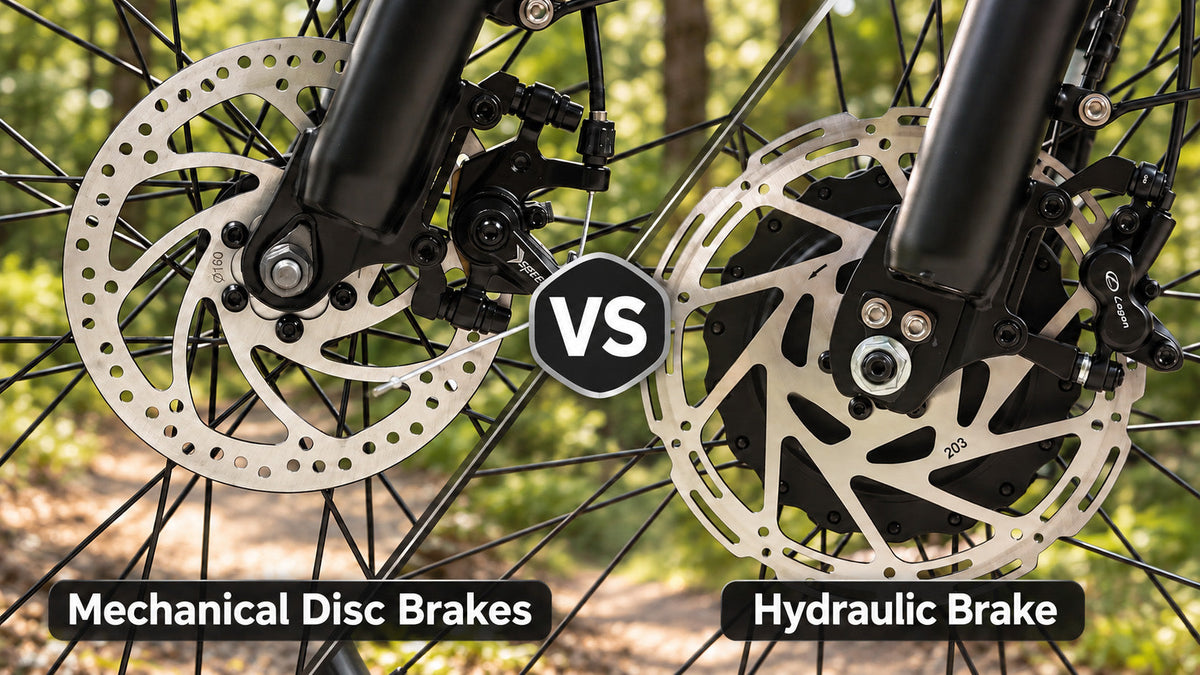
Hydraulic vs Mechanical Disc Brakes on E-Bikes: Which Is Better?
Hydraulic disc brakes are generally the better choice for heavier e-bikes, frequent hills, loaded riding and all-terrain use because they can deliver strong, progressive braking with less hand effort. Mechanical disc brakes remain a practical option for lower-cost urban e-bikes and riders who prioritise simple cable-based maintenance.
However, the word “hydraulic” does not automatically guarantee better stopping performance. Rotor size, brake-pad material, caliper design, tyre grip, correct installation and regular maintenance are also important.
This guide explains how hydraulic and mechanical disc brakes work, how they feel on the road and which system is likely to suit your e-bike riding style.
What Is a Mechanical Disc Brake?
A mechanical disc brake uses a steel cable to connect the brake lever to the caliper.
When the rider pulls the lever:
-
The brake lever pulls the cable.
-
The cable moves an arm on the brake caliper.
-
The caliper presses the brake pads against the rotor.
-
Friction between the pads and rotor slows the wheel.
The operating principle is straightforward and familiar to anyone who has worked with traditional cable-operated bicycle brakes.
Mechanical disc brakes are commonly found on affordable commuter bicycles, entry-level e-bikes and models designed for relatively simple maintenance.
What Is a Hydraulic Disc Brake?
A hydraulic disc brake uses fluid inside a sealed hose instead of a conventional brake cable.
When the rider pulls the lever:
-
A piston inside the brake lever pressurises the brake fluid.
-
Pressure moves through the sealed hose.
-
Pistons inside the caliper move towards the rotor.
-
The brake pads contact the rotor and slow the wheel.
Because pressure is transferred through fluid, a hydraulic system can usually produce a smooth and controlled response with relatively little hand effort.
The WILDEWAY SOARED Pro and SOARED Max use front and rear hydraulic disc brakes with 180mm rotors. This configuration is intended to support the braking requirements of a substantial all-terrain e-bike.
Hydraulic vs Mechanical Disc Brakes at a Glance
| Feature | Hydraulic disc brakes | Mechanical disc brakes |
|---|---|---|
| Actuation | Sealed fluid system | Steel cable |
| Lever effort | Generally lower | Generally higher |
| Braking modulation | Usually smoother and more progressive | More direct, depending on setup |
| Pad-wear compensation | Usually automatic | Usually requires manual adjustment |
| Routine adjustment | Less frequent when operating correctly | Cable tension may need regular adjustment |
| Home servicing | Requires correct fluid, tools and knowledge | Generally easier for basic home maintenance |
| Trailside repair | More difficult | Cable repairs may be simpler |
| Purchase cost | Usually higher | Usually lower |
| Typical application | Performance, cargo and all-terrain e-bikes | Budget and everyday urban bicycles |
These are general differences. A high-quality, correctly adjusted mechanical system can outperform a poorly installed or neglected hydraulic system.
1. Braking Power
Hydraulic brakes can normally generate substantial clamping force without requiring the rider to squeeze the lever as hard.
This can be useful on an e-bike because electric bicycles are often heavier than conventional bicycles. Additional battery, motor, rack and cargo weight all increase the amount of energy the brakes must manage.
Hydraulic braking may be especially valuable when:
-
Descending long or steep hills.
-
Carrying luggage.
-
Riding a heavier all-terrain bicycle.
-
Making repeated stops in urban traffic.
-
Riding on loose or changing surfaces.
-
Using the bicycle for longer journeys.
-
The rider has limited hand strength.
Mechanical disc brakes can still provide adequate braking for everyday riding when they are correctly sized, installed and maintained. Their performance depends heavily on cable condition, caliper adjustment and pad alignment.
2. Modulation and Control
Braking power describes how strongly a system can slow the bicycle. Modulation describes how easily the rider can control the amount of braking between light contact and maximum force.
Good modulation allows the rider to:
-
Reduce speed gently before a corner.
-
Control the bicycle on loose gravel.
-
Avoid abruptly locking a wheel.
-
Maintain a steady speed on a descent.
-
Make small adjustments in stop-and-start traffic.
Hydraulic brakes are usually known for smooth, progressive lever response. The rider can apply light pressure for a small reduction in speed and gradually increase that pressure when more braking is required.
Mechanical brakes may feel more direct and can still offer good control, but cable friction, contamination or tight bends in the cable housing can affect their consistency.
No brake can overcome the available tyre grip. Pulling the lever too hard on wet leaves, loose gravel, ice or polished road markings can still cause a wheel to lose traction.
3. Hand Effort and Rider Fatigue
The difference in lever effort may be difficult to notice during one stop on a flat road. It becomes more important during a long descent or a journey involving repeated braking.
A rider using mechanical brakes may need to apply more hand force, particularly if the cables are dirty, corroded or poorly routed.
A hydraulic system can usually deliver the required pressure with less effort. This may reduce hand and forearm fatigue for riders who:
-
Travel through hilly areas.
-
Ride for several hours.
-
Make frequent delivery or commuting stops.
-
Carry cargo.
-
Have reduced grip strength.
-
Use a heavier e-bike.
Brake-lever reach also matters. A powerful brake is difficult to control if the lever is positioned too far from the rider’s fingers. Where adjustment is available, it should be set according to the manufacturer’s instructions.
4. Adjustment as the Pads Wear
Disc brake pads become thinner through normal use.
Most modern hydraulic systems compensate for gradual pad wear by allowing the caliper pistons to move farther towards the rotor. This helps maintain a relatively consistent lever position until the pads require replacement.
Mechanical systems normally require periodic adjustment to maintain the correct distance between the pads and rotor. Depending on the design, the rider or technician may need to adjust:
-
Cable tension.
-
The fixed brake pad.
-
The moving brake pad.
-
Caliper alignment.
-
Brake-lever travel.
This does not make mechanical brakes unreliable. It means their condition and adjustment may require more frequent attention.
5. Maintenance and Repair
Mechanical brakes are generally easier for riders who want to perform basic maintenance using common bicycle tools.
A worn or damaged cable can often be inspected and replaced without opening a hydraulic system. This may be useful for riders travelling in areas where specialist e-bike servicing is limited.
Hydraulic brakes require different procedures. Depending on the system, maintenance may include:
-
Checking the hose and connections.
-
Replacing worn pads.
-
Cleaning or realigning the caliper.
-
Bleeding air from the system.
-
Replacing contaminated or degraded fluid.
-
Inspecting pistons and seals.
Hydraulic systems do not all use the same brake fluid. Some use mineral oil, while others use DOT fluid. These fluids must never be treated as interchangeable.
Use only the fluid, bleed kit, replacement pads and procedures specified by the brake manufacturer. Using the wrong fluid can damage seals and create a serious safety risk.
If the lever feels unusually soft, approaches the handlebar or changes suddenly, stop riding and arrange an inspection.
6. Performance in Rain and Mud
Both hydraulic and mechanical disc brakes position their braking surface at the wheel hub rather than at the rim. This generally helps disc brakes provide predictable performance in wet or dirty conditions.
The system still requires care after riding in mud or rain.
Check for:
-
Mud around the caliper.
-
Unusual scraping sounds.
-
Contaminated brake pads.
-
Damaged hoses or cables.
-
Bent rotors.
-
Changes in lever feel.
-
Reduced braking power.
A hydraulic hose is sealed against normal external contamination. A mechanical cable can develop additional friction when dirt or moisture enters damaged cable housing.
The rotor and pads of either system can be contaminated by chain lubricant, grease, cleaning spray or other chemicals. Never apply lubricant to a brake rotor or brake pad.
7. Heat Management and Rotor Size
Brakes convert the bicycle’s movement into heat. Long descents, repeated hard stops and heavier loads can create more heat at the rotors and pads.
Larger rotors can provide additional leverage and more surface area for managing heat, but rotor size must be compatible with the frame, fork, caliper and manufacturer-approved adapters.
The SOARED Pro and Max product page specifies 180mm front and rear rotors. Together with hydraulic calipers, this creates a braking configuration suited to the model’s large all-terrain design.
Riders should not install a larger rotor simply because it appears more powerful. The frame and fork must be approved for the selected size, and the caliper must be positioned correctly.
8. Which System Costs More?
Mechanical disc brakes normally have a lower initial purchase price. Replacement cables and housing are also widely available and relatively inexpensive.
Hydraulic brakes generally cost more because the system includes:
-
Hydraulic brake levers.
-
Sealed hoses.
-
Caliper pistons and seals.
-
Brake fluid.
-
More specialised servicing procedures.
The relevant question is not only which system costs less. It is whether the braking performance and maintenance experience match the bicycle.
For a lightweight bicycle used on short, flat urban journeys, a properly maintained mechanical system may be sufficient. For a heavier e-bike used on hills, mixed terrain or with cargo, the additional control of hydraulic brakes may justify the higher cost.
9. What Else Determines E-Bike Braking Performance?
Brake type is only one part of the complete system.
Actual braking performance also depends on:
Tyre grip
The brakes can stop the wheel from rotating, but the tyres must transfer that force to the ground.
Rotor diameter
Rotor size affects braking leverage and heat management.
Brake-pad material
Different pad compounds can affect noise, initial bite, durability and heat performance.
Bicycle weight
A heavier bicycle or loaded rear rack increases the energy the brakes must manage.
Rider technique
Using both brakes progressively is generally more controlled than suddenly applying one brake.
Maintenance
Worn pads, contaminated rotors or a damaged cable or hose can significantly reduce performance.
Road surface
Water, gravel, mud, leaves, paint and metal covers can reduce available grip.
Even premium brakes need realistic stopping distances and appropriate riding speed.
10. A Five-Minute Brake Inspection
Before a longer ride, perform a simple brake check.
Brake levers
Pull each lever separately. It should feel consistent and should not touch the handlebar.
Brake hoses or cables
Look for damage, leakage, fraying, corrosion or sharp bends.
Brake pads
Confirm that sufficient friction material remains. Follow the brake manufacturer’s replacement limits.
Rotors
Check for visible damage, contamination or excessive movement from side to side.
Calipers
Make sure the mounting bolts appear secure and the caliper is correctly positioned.
Low-speed test
Test both brakes in a safe area before entering traffic or beginning a descent.
Arrange professional servicing if braking performance changes, the lever feels unusual or you are uncertain about any component.
Who Should Choose Hydraulic Disc Brakes?
Hydraulic disc brakes are generally the stronger choice for riders who:
-
Own a heavier e-bike.
-
Regularly ride on hills.
-
Carry luggage or equipment.
-
Ride on gravel or uneven surfaces.
-
Want smoother lever control.
-
Prefer lower hand effort.
-
Make frequent stops.
-
Expect to ride in changing weather.
They are particularly appropriate for a substantial all-terrain platform such as the SOARED Pro or SOARED Max.
Who May Prefer Mechanical Disc Brakes?
Mechanical disc brakes may suit riders who:
-
Mostly ride short and flat urban routes.
-
Want a lower purchase price.
-
Prefer straightforward cable maintenance.
-
Travel where hydraulic service is difficult to find.
-
Are comfortable making routine brake adjustments.
-
Use a relatively light and simply equipped bicycle.
The best choice depends on the complete bicycle and how it will be used—not the brake label alone.
Why the SOARED Uses Hydraulic Disc Brakes
The SOARED platform is designed around long-range and mixed-terrain riding. The Pro and Max share the same robust frame platform, 26×4.0-inch tyres, full-suspension layout and large removable battery.
The official product page specifies front and rear hydraulic disc brakes with 180mm rotors. This configuration supports controlled braking for a substantial bicycle that may be used on hills, unpaved routes and longer journeys.
Hydraulic brakes do not remove the need for correct riding technique. Riders should still:
-
Use both brakes progressively.
-
Reduce speed before entering a corner.
-
Allow more stopping distance when carrying cargo.
-
Avoid sudden braking on loose surfaces.
-
Check the brakes before every ride.
-
Arrange servicing when performance changes.
Public-road rules and permitted e-bike configurations vary across Europe. Always confirm that the bicycle configuration and intended use comply with the requirements of the country and location in which it will be ridden.
Final Thoughts
Hydraulic disc brakes generally provide lower lever effort, smoother modulation and less frequent pad-clearance adjustment. These qualities make them well suited to heavier e-bikes, hills, cargo and all-terrain riding.
Mechanical disc brakes remain affordable, functional and easier to repair with standard cables and tools. When properly adjusted, they can be a reasonable choice for everyday urban use.
Whichever system you choose, correct installation and maintenance matter more than the name printed on the brake lever.
Inspect the pads, rotors, hoses or cables regularly. Keep oil away from the braking surfaces. Test both brakes before riding and seek professional help whenever braking power or lever feel changes.
For riders looking for a long-range all-terrain platform equipped with front and rear hydraulic disc brakes and 180mm rotors, explore the WILDEWAY SOARED Pro and SOARED Max.
Frequently Asked Questions
Are hydraulic brakes better for an e-bike?
Hydraulic brakes are generally better suited to heavier e-bikes, hills, cargo and all-terrain riding because they can provide strong, progressive braking with relatively little hand effort.
Are mechanical disc brakes safe?
Yes, when correctly selected, installed, adjusted and maintained. Their suitability depends on the bicycle’s weight, speed, load and intended riding environment.
Do hydraulic e-bike brakes need regular bleeding?
Not according to a single universal schedule. Bleeding may be required when the lever feels soft, air enters the system or the brake manufacturer specifies a service interval.
Can I use any brake fluid in a hydraulic brake?
No. Use only the exact fluid specified by the brake manufacturer. Mineral oil and DOT brake fluid are not interchangeable.
Why are my e-bike disc brakes making noise?
Possible causes include water, dirt, pad or rotor contamination, incorrect caliper alignment, worn pads or a damaged rotor. Persistent noise or reduced performance should be inspected.
Do bigger brake rotors always stop an e-bike faster?
Not automatically. Larger rotors can improve leverage and heat management, but they must be approved for the frame and fork and installed with the correct adapters.
How often should I inspect my e-bike brakes?
Perform a basic function check before every ride and a closer visual inspection regularly. Riding frequency, hills, weather, total load and surface conditions all affect wear.
Partager:
How to Plan a 20–40 km E-Bike Commute in Europe
How to Store an E-Bike for Winter: Complete Checklist