
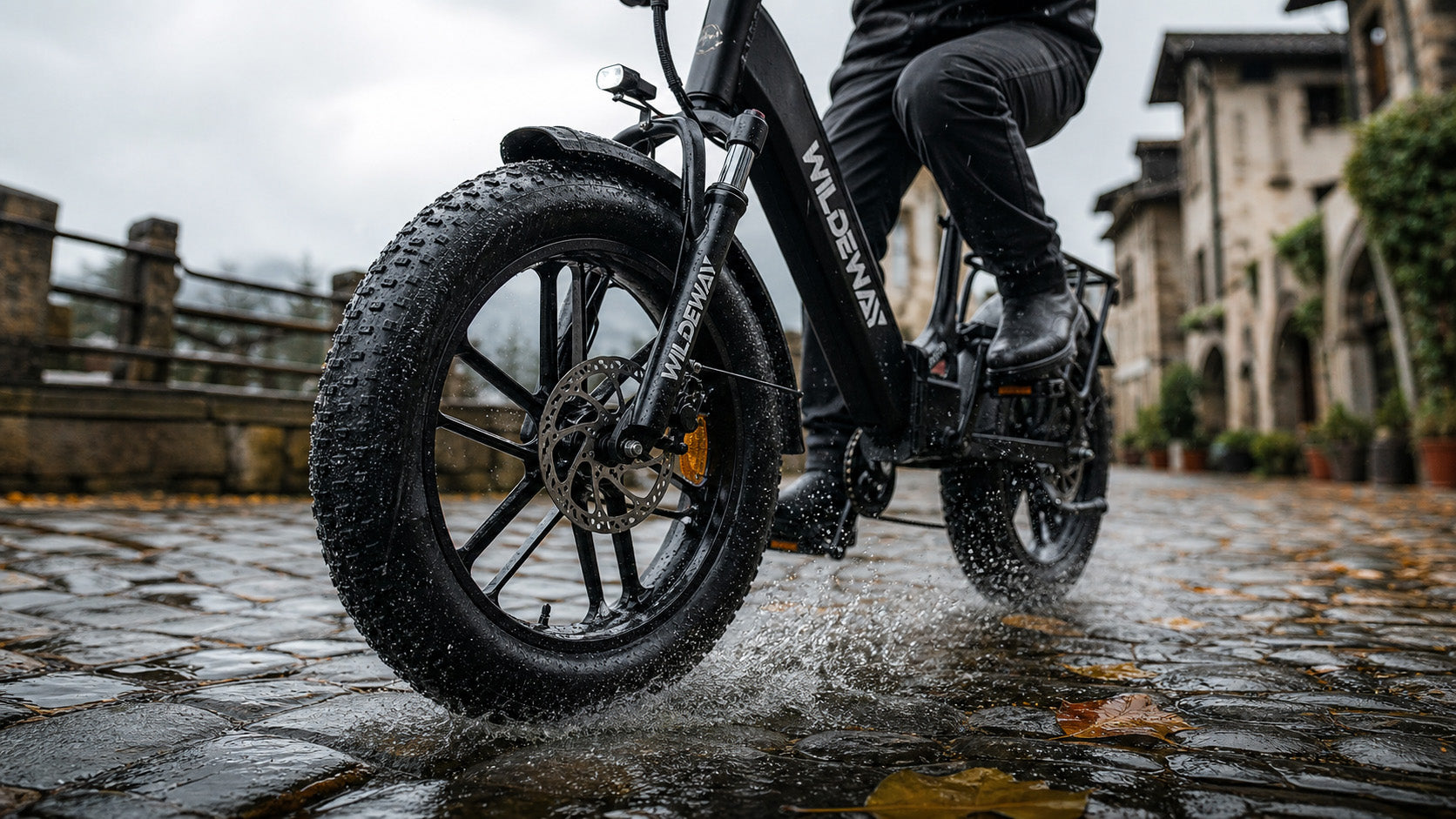
Why Fat Tires Are Safer on Wet and Slippery Roads: The Science of Grip
It’s a feeling every cyclist dreads. You are riding home on a rainy autumn evening, you gently squeeze your brakes, and instantly—you feel that terrifying loss of control as your tires slide across the wet pavement.
In European cities, autumn and winter bring a unique set of hazards: wet cobblestones, slippery fallen leaves, slick painted bike lanes, and the ultimate cyclist trap—wet tram tracks.
If you are riding a traditional commuter bicycle with thin, high-pressure tires, your risk of slipping is incredibly high. But if you are riding an e-bike equipped with fat tires (typically 4.0 inches wide), the rules of the road completely change.
Let's dive into the hardcore physics of why fat tires are vastly superior and significantly safer when the weather turns bad.
1. The Physics of the "Contact Patch"
The secret to tire safety all comes down to one technical term: The Contact Patch. This is the exact amount of rubber that is physically touching the ground at any given second.
- Thin Tires: A standard road or city bike tire has a contact patch roughly the size of a single coin. When you hit a wet patch of road, all of your weight and braking force is concentrated into that tiny area. If that small spot loses grip, you crash.
- Fat Tires: A 4.0-inch fat tire has a contact patch that is massive—sometimes 4 to 5 times larger than a standard tire. More rubber on the road means more friction. If one inch of the tire slides on a wet leaf, the other three inches are still gripping the rough asphalt, keeping you upright and stable.
2. Lower Tire Pressure = A Flexible "Foot"
Traditional bike tires must be pumped up to very high pressures (often 60 to 100 PSI) to avoid flat tires. This makes them rock hard. When a hard tire hits a wet, uneven surface (like a cobblestone), it bounces off it, instantly losing traction.
Fat tires are designed to run at significantly lower pressures (typically 10 to 20 PSI). Because they hold a massive volume of air, they don't need to be rock hard.
When a softer fat tire rolls over a wet cobblestone or a bumpy root, it doesn't bounce; it deforms and wraps around the object. The tire acts like a flexible foot, grabbing the uneven surface rather than deflecting off it. This provides incredible stability on unpredictable terrain.
3. Conquering the Ultimate Danger: Tram Tracks
Any cyclist living in cities like Berlin, Amsterdam, or Milan knows the terror of tram tracks. Thin bicycle tires are the exact same width as the gaps in the metal tracks. In the rain, these metal rails become as slippery as ice. If your thin tire slips into that gap, you are going over the handlebars.
Fat tires are physically wider than tram track gaps. You simply cannot get your wheel stuck in the rails. Furthermore, the aggressive knobby tread pattern on fat tires provides enough grip to safely cross over wet metal rails without the wheel slipping out from under you.
4. Water Displacement and Hydroplaning
Have you ever driven a car through a deep puddle and felt the steering wheel go light? That is hydroplaning—when a layer of water builds up between your tire and the road.
Fat tires feature deep, aggressive tread patterns with large grooves. These grooves act as drainage channels. As the heavy e-bike rolls forward, the weight pushes the water out through these channels, allowing the rubber blocks to make direct contact with the solid ground beneath the puddle.
The Safest Ride in the Rain: The WILDEWAY Torpedo
Understanding the science is great, but experiencing the safety firsthand is life-changing. If you want to ride with absolute confidence through all four European seasons, the [WILDEWAY Torpedo] is engineered to protect you.
The Torpedo doesn't just look aggressive; every component is designed for maximum safety and control in poor conditions:
- 20x4.0 All-Terrain Fat Tires: Providing a massive contact patch and deep water-channeling treads to keep you glued to wet roads and muddy paths.
- Dual Disc Brakes: When you need to stop in the rain, traditional rim brakes slip and fail. The Torpedo’s disc brakes provide instant, powerful stopping force, no matter how wet the wheels get.
- Front Suspension: Working in harmony with the fat tires, the suspension fork keeps your front wheel planted firmly on the ground over bumps, ensuring you never lose steering control.
- Rust-Proof Mag Wheels: Wet weather means rust for standard wire spokes. The Torpedo features stunning 5-spoke solid alloy wheels that will never rust or snap, keeping your wheels perfectly aligned.
Ride with Confidence
Don’t let a little rain force you back into a crowded bus. By upgrading to a fat tire e-bike, you are putting physics on your side.
👉 [Experience the ultimate all-weather grip. Discover the WILDEWAY Torpedo today.]
Teilen:
Silent Power: Why the WILDEWAY SOARED is the New Essential Gear for Hunters and Anglers
Mastering the Uphill: How to Use AWD and Gears for Steep Inclines