
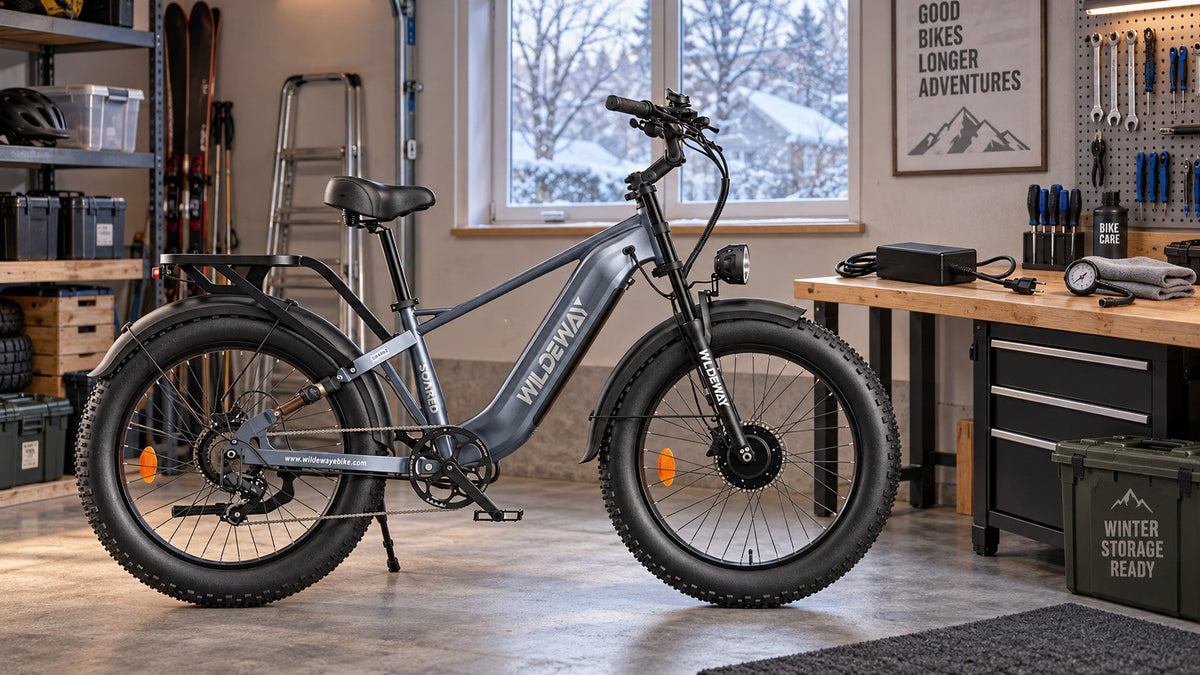
How to Store an E-Bike for Winter: A Complete Battery and Bike Checklist
Correct winter storage protects more than the appearance of an electric bicycle. It helps preserve the battery, reduces corrosion, prevents tyres from remaining underinflated for months and makes the bicycle safer to return to service in spring.
The basic process is straightforward:
-
Clean and dry the bicycle thoroughly.
-
Inspect it for damage and excessive wear.
-
Store the battery according to the manufacturer’s instructions.
-
Keep the bicycle in a dry, secure location.
-
Check the battery and tyres periodically.
-
Complete a full safety inspection before riding again.
The precise battery charge level and permitted temperature range depend on the battery system. Always follow the instructions supplied with your e-bike, battery and charger rather than applying figures intended for another brand.
This guide explains how to prepare an e-bike for several weeks or months of winter storage.
Should You Store an E-Bike for Winter?
Many European riders continue cycling throughout winter. If roads remain safe and the bicycle is equipped and maintained for the conditions, complete seasonal storage may not be necessary.
Long-term storage may be appropriate when:
-
Snow or ice regularly makes local routes unsafe.
-
Road salt is used extensively.
-
The bicycle is used mainly for leisure or touring.
-
The rider will be away for several weeks or months.
-
The e-bike would otherwise remain unused in an exposed location.
-
Local winter weather makes battery charging and maintenance difficult.
Even if you plan to ride occasionally, preparing a clean, dry storage space and following safe battery practices remains worthwhile.
Why Winter Storage Requires Preparation
An unused e-bike continues to be affected by its environment.
Potential problems include:
-
Gradual battery discharge.
-
Moisture entering damaged seals or connectors.
-
Corrosion caused by salt and dirt.
-
Tyres losing pressure.
-
Hydraulic or mechanical components developing problems.
-
Chains and exposed steel components rusting.
-
Brake pads or rotors becoming contaminated.
-
Rodents damaging cables or soft materials.
-
Theft from an unsecured garage, shed or communal storage area.
A bicycle stored while dirty and wet may deteriorate more quickly than one that is regularly ridden and maintained.
1. Choose a Dry and Secure Storage Location
The ideal location is dry, stable and protected from severe temperature changes.
Possible locations include:
-
A secure indoor storage room.
-
A dry garage.
-
A locked bicycle room.
-
A well-ventilated workshop.
-
A weatherproof shed without condensation problems.
Avoid leaving the bicycle outdoors under a simple cover for an entire winter. A cover may protect against direct rain, but it can also trap moisture and encourage condensation if ventilation is poor.
The storage area should not:
-
Regularly flood or develop standing water.
-
Expose the bicycle to dripping condensation.
-
Place it beside corrosive chemicals or fertilisers.
-
Position the battery beside a heater or direct heat source.
-
Block a doorway, corridor or emergency exit.
-
Allow children or pets to interfere with the battery or charger.
Where the e-bike must remain in a garage or shed, inspect the area after cold nights to see whether condensation forms on metal surfaces.
2. Wash the E-Bike Before Storage
Mud, road salt, sand and organic debris hold moisture against components. Clean the bicycle before putting it away.
First, switch off the electrical system and remove the battery if the manufacturer’s instructions allow it. Close any battery-port cover correctly.
Use:
-
A soft brush.
-
A damp cloth or sponge.
-
Mild bicycle-compatible cleaner.
-
Clean water applied at low pressure.
-
A separate clean cloth for drying.
Avoid directing high-pressure water at:
-
Battery terminals.
-
Electrical connectors.
-
Hub-motor axles.
-
Bearings.
-
The display and controls.
-
Suspension seals.
-
Brake calipers.
-
Frame openings.
A pressure washer can force water beyond seals that resist ordinary rain and splashing.
After cleaning, dry the bicycle carefully. Pay particular attention to joints, bolt heads, the chain, the underside of the frame and areas around the battery compartment.
Do not place the bicycle into long-term storage while moisture remains trapped around electrical connections or metal components.
3. Inspect the Bicycle While It Is Clean
Cleaning provides a good opportunity to identify problems that could become worse during storage.
Check the frame and fork for:
-
Cracks.
-
Dents.
-
Paint damage.
-
Loose fasteners.
-
Abnormal movement.
-
Damage around hinges or joints, where applicable.
Check the wheels and tyres for:
-
Cuts or embedded objects.
-
Cracked sidewalls.
-
Damaged tyre beads.
-
Bent rims.
-
Loose or damaged spokes.
-
Significant tread wear.
-
Sealant leakage if an approved tubeless system is used.
Check the electrical system for:
-
Damaged cable insulation.
-
Crushed or stretched wiring.
-
Bent connector pins.
-
Moisture or corrosion.
-
A loose display or control unit.
-
Damage near the motor axle.
Arrange repairs before storage when possible. A problem that is forgotten during winter may be missed when the bicycle is quickly returned to service in spring.
4. Prepare the Chain and Drivetrain
A dirty chain can hold moisture and encourage corrosion.
Clean the chain, chainring, cassette and derailleur with suitable bicycle products. Allow the drivetrain to dry, then apply a compatible bicycle-chain lubricant according to its instructions.
After applying lubricant:
-
Rotate the cranks to distribute it.
-
Allow sufficient time for penetration.
-
Wipe excess lubricant from the outside of the chain.
-
Keep lubricant away from the brake rotors and pads.
Applying excessive lubricant does not improve protection. It can attract dust and may contaminate braking surfaces.
If the chain is already heavily rusted, stretched or damaged, replacement may be more appropriate than storage treatment.
5. Remove and Inspect the Battery
The battery is one of the most valuable components of an e-bike and requires product-specific care.
If the battery is designed to be removable:
-
Switch off the e-bike.
-
Remove the key where applicable.
-
Release the battery using the correct procedure.
-
Support its weight with both hands.
-
Inspect the casing and terminals.
-
Store it where it cannot fall or be struck.
Do not use a battery that shows:
-
Swelling.
-
Cracking.
-
Severe impact damage.
-
Leakage.
-
Burn marks.
-
Unusual heat.
-
An abnormal smell.
-
Damaged terminals.
-
Evidence of water entering the casing.
A damaged lithium-ion battery should not be charged or returned to ordinary household storage. Keep people away from it and seek advice from the manufacturer, retailer or an authorised disposal service. If it is hot, smoking or emitting vapour, leave the area and contact the emergency services.
Never open the battery casing or attempt to repair its internal cells.
6. Use the Correct Storage Charge Level
Do not assume that every e-bike battery should be stored completely full or almost empty.
Battery manufacturers commonly specify a partial state of charge for long-term storage, but the correct range varies between systems. Consult the instructions supplied with the bicycle and battery.
Before storage:
-
Confirm the recommended charge range.
-
Use only the approved charger.
-
Do not leave the charger connected indefinitely.
-
Disconnect it when charging is complete.
-
Do not attempt to charge a visibly damaged battery.
-
Record the approximate charge level and storage date.
If the manual specifies periodic charge checks, add the dates to a calendar. Lithium-ion batteries gradually discharge even when not being used.
Do not repeatedly charge the battery to 100% merely because the indicator has fallen slightly. Follow the manufacturer’s long-term storage procedure.
7. Let a Cold Battery Reach an Approved Charging Temperature
A battery brought inside after exposure to cold weather may be colder than the surrounding room.
Do not automatically connect it to the charger immediately. Allow it to reach the charging-temperature range specified by the manufacturer. This also gives any surface condensation time to disappear.
Place the battery in a dry and stable location while it adjusts. Do not accelerate warming by putting it:
-
On a radiator.
-
Beside a heater.
-
In direct contact with a hot surface.
-
Under an electric blanket.
-
In an oven or heated cabinet.
The same principle applies when taking a battery from a very cold storage area. Temperature requirements for riding, charging and storage may be different, so check the relevant section of the manual.
8. Store and Charge the Battery Safely
Safe winter battery storage is not only about preserving capacity. It is also about reducing fire risk.
Store the battery:
-
In a dry location.
-
Within its manufacturer-approved temperature range.
-
Away from flammable materials.
-
Away from direct sunlight.
-
Away from heat sources.
-
On a stable surface.
-
Where it cannot block an escape route.
-
Out of reach of children and pets.
When charging:
-
Use the charger supplied or specifically approved for the battery.
-
Check the charger and cable for damage.
-
Place the battery and charger on a hard, stable surface.
-
Keep ventilation openings clear.
-
Do not cover the charger or battery.
-
Remain awake and present.
-
Disconnect the charger after charging.
-
Follow the manufacturer’s instructions and local fire-safety guidance.
Do not use an unapproved charger simply because its connector fits. Voltage, current, communication and battery-management requirements may differ.
9. Protect the Battery Contacts
With the battery removed, inspect the bicycle’s battery compartment and connection points.
The contacts should remain clean and dry. Do not insert metal objects, abrasive tools or unsuitable chemicals into the connector.
Use the protective cover supplied with the bicycle where applicable. If no cover is provided, follow the manufacturer’s instructions rather than improvising with a material that may trap moisture.
Keep the key in a safe place, but not in the battery lock. Attach a label or reminder if you are likely to forget where it is stored.
10. Maintain Tyre Pressure During Storage
Bicycle tyres naturally lose air over time. A heavy e-bike left for several months on severely underinflated tyres can place unnecessary stress on the tyre casing and tube.
Before storage:
-
Inspect both tyres for damage.
-
Inflate them within the permitted range printed on the tyre.
-
Confirm any separate rim limits.
-
Use a reliable pressure gauge.
-
Position the bicycle on a level surface.
Check the pressure periodically during storage. Do not exceed the permitted pressure in an attempt to make it last through the winter.
If practical and approved for the bicycle, a suitable stand can reduce prolonged loading on the tyres. The stand must support the e-bike securely without stressing the frame, motor cables, display or brake controls.
For a substantial fat-tyre model, make sure any stand is rated for the bicycle’s weight and tyre width.
11. Check the Brakes
Brake rotors should be clean and dry before storage.
Do not apply oil, corrosion spray or chain lubricant to:
-
Brake rotors.
-
Brake pads.
-
Caliper braking surfaces.
-
Tyre tread.
Pull each brake lever and confirm that it feels normal. Inspect the hydraulic hoses or mechanical cables for damage.
Long-term storage does not eliminate the need for a spring brake inspection. Changes in lever feel, leakage, contamination or corrosion require attention before the bicycle is ridden.
12. Protect the Suspension
For an e-bike with suspension, clean dirt from the exposed stanchions and seals using a soft cloth. Follow the suspension manufacturer’s maintenance instructions.
Do not apply a random oil or general-purpose spray to the suspension. Some chemicals can damage seals or attract abrasive dirt.
If the suspension is leaking, scratched or no longer operating normally, arrange professional inspection rather than leaving the issue until the next riding season.
13. Secure the Bicycle Against Theft
A garage, basement or communal bicycle room should not automatically be treated as secure.
Consider:
-
Locking the frame to an immovable anchor.
-
Using a high-quality lock appropriate to the location.
-
Removing the display if designed to be removable.
-
Storing the battery separately.
-
Recording the frame number.
-
Keeping proof of purchase.
-
Photographing the bicycle and its identifying features.
-
Checking insurance requirements.
Avoid locking only a wheel. A wheel can sometimes be removed while the remainder of the bicycle is stolen.
Do not store keys, charger documentation and proof of ownership beside the bicycle.
14. Perform Monthly Winter Checks
A stored e-bike does not require daily attention, but it should not be ignored for an entire season.
Create a simple inspection schedule.
Check:
-
Whether the storage location remains dry.
-
Whether condensation is developing.
-
Battery charge, when required by the manual.
-
Tyre pressure.
-
Signs of corrosion.
-
Pest or rodent damage.
-
Lock condition.
-
Whether the bicycle has fallen or been moved.
-
Any unusual battery appearance or smell.
Do not repeatedly switch on the bicycle merely to confirm that it works. Follow the battery manufacturer’s recommended checking procedure.
15. Avoid These Common Winter-Storage Mistakes
Storing the e-bike while wet
Moisture, mud and road salt can remain hidden around fasteners and electrical components.
Leaving the battery completely discharged
A deeply discharged battery may deteriorate or enter a protective state from which it cannot be normally recovered.
Assuming 100% is always best
Full charge may not be the recommended condition for several months of inactivity.
Using an incompatible charger
A fitting connector does not prove electrical compatibility.
Charging while asleep or away
Battery charging should be supervised according to the manufacturer’s and local fire authority’s guidance.
Covering the battery or charger during charging
Heat must be able to dissipate.
Keeping the bicycle on flat tyres
Pressure should be checked periodically.
Spraying the entire bike with oil
Oil can contaminate the brakes and attract dirt.
Forgetting security
Indoor and communal storage areas can still be targeted by thieves.
How to Return the E-Bike to Service
Do not take an e-bike directly from several months of storage onto a long or demanding ride.
Complete a recommissioning inspection first.
Battery
Check the battery casing, contacts and mounting mechanism. Charge it using the approved charger and correct procedure. Stop if the battery behaves abnormally.
Tyres and wheels
Inflate the tyres to a suitable pressure within the permitted range. Check tread, sidewalls, rims, spokes and wheel alignment.
Brakes
Test each brake separately. The levers should feel consistent and should not pull against the handlebar. Inspect the pads and rotors.
Drivetrain
Check chain lubrication, gear operation and derailleur condition.
Fasteners and controls
Inspect the handlebar, stem, saddle, pedals, racks, mudguards and other fitted equipment.
Electrical system
Confirm that the display, assistance controls, lights and motor system operate normally.
Low-speed test
Start with a controlled ride in a safe area. Test steering, braking and assistance before entering traffic or beginning an off-road route.
Arrange professional servicing if you detect an unusual sound, warning code, unstable handling, weak braking, damaged cable or abnormal battery behaviour.
Winter Storage for the WILDEWAY SOARED
The WILDEWAY SOARED Pro and SOARED Max use a removable battery and a substantial all-terrain platform with 26×4.0-inch tyres, full suspension and hub motors.
These characteristics make several storage steps particularly important:
-
Support the bicycle securely because of its size and weight.
-
Maintain appropriate tyre pressure during inactivity.
-
Protect the motor cables and axle areas from moisture.
-
Keep the battery contacts clean and dry.
-
Do not balance the bicycle on its display or brake controls.
-
Use stands and wall mounts rated for the bicycle’s actual weight.
-
Follow the battery and charger instructions supplied with the model.
The bicycle’s all-terrain design does not make it immune to corrosion, battery damage or neglected maintenance. Correct winter storage protects the equipment and helps provide a safer return to riding.
Final Thoughts
Good winter storage begins before the bicycle is parked.
Clean and dry the e-bike, repair existing problems, protect the drivetrain and store the removable battery according to its own instructions. Keep the bicycle in a dry, secure location and check the battery and tyre pressure periodically.
When spring arrives, inspect the complete bicycle before riding. A few careful checks are far less expensive than replacing a damaged battery, tyre, brake component or electrical connector.
To explore a long-range, fat-tyre all-terrain platform with a removable battery, view the current specifications of the WILDEWAY SOARED Pro and SOARED Max.
Frequently Asked Questions
Should I remove my e-bike battery for winter storage?
Remove it if the bicycle and battery manufacturer recommend this and it can be done safely. A removable battery can then be kept in an approved dry location away from severe temperature changes and flammable materials.
Should an e-bike battery be stored fully charged?
Not necessarily. Many battery systems specify a partial charge for long-term storage. Follow the charge range stated in the instructions for your particular battery rather than applying a universal percentage.
Can I store an e-bike in a cold garage?
The bicycle may be stored in a dry garage if its components remain within their approved storage conditions. The battery may have different temperature requirements and may need to be removed. Watch for condensation and moisture.
How often should I check a stored e-bike battery?
Follow the battery manufacturer’s recommended interval. Check periodically if the instructions require it, because the battery will gradually discharge even when it is not being used.
Can I leave the charger connected all winter?
No. Charge the battery according to its instructions, supervise charging and disconnect the charger when charging is complete. Do not treat the charger as a permanent storage connection unless the manufacturer explicitly provides such a function.
Should I cover an e-bike during winter storage?
A breathable cover can help protect a clean bicycle from dust. Do not use a wet or airtight covering that traps moisture, and never cover the battery or charger while charging.
Do I need to service the e-bike before riding in spring?
At minimum, inspect the battery, tyres, wheels, brakes, drivetrain, fasteners and electrical system. Arrange professional servicing if anything is damaged, feels abnormal or cannot be confidently checked.
Aktie:
Hydraulic vs Mechanical Disc Brakes on E-Bikes: Which Is Better?
27.5” Trail E-MTB vs. 26x4.0 Fat Tire: Choosing the Ultimate Full-Suspension E-Bike for European Terrain