
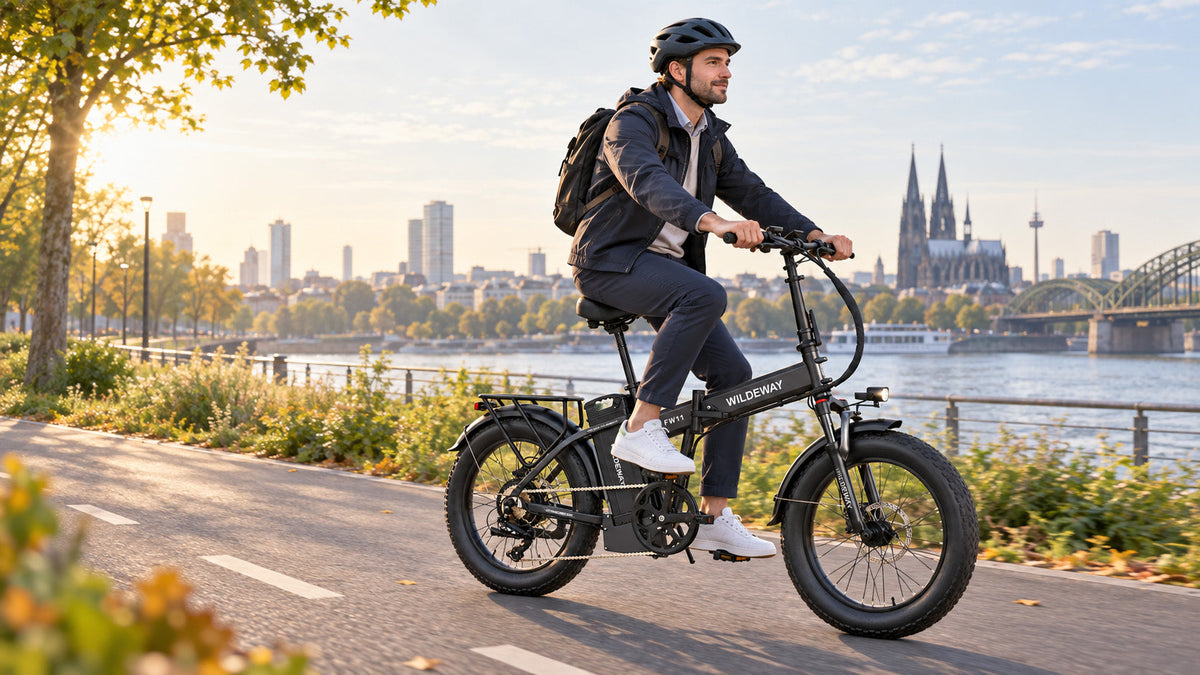
How to Plan a 20–40 km E-Bike Commute in Europe
A 20–40 km daily e-bike commute can be practical if you choose a suitable route, maintain a realistic battery reserve, carry luggage securely and use a bicycle that remains comfortable over longer distances. The goal is not simply to buy the largest battery available. A successful commute depends on the complete system: range, riding position, tyres, brakes, lighting, storage and local road regulations.
Cycling is becoming a more established part of European transport. According to the European Commission’s 2026 Cycling Counts study, the EU has more than 900,000 km of cycling paths and lanes, while almost 24% of EU residents cycle at least once per week. Infrastructure quality still varies considerably between countries and cities, but longer bicycle commutes are increasingly realistic for many people.
If you are considering replacing part of your car or public-transport journey with an e-bike, this guide will help you plan a 20–40 km daily round trip.
Is a 20–40 km Daily E-Bike Commute Realistic?
For many riders, yes. Electric assistance reduces the effort required for hills, headwinds and repeated starts, making longer routes more manageable than they would be on a conventional bicycle.
However, distance alone does not determine whether a commute is practical. Consider:
-
How much of the route uses protected cycle infrastructure.
-
The number and steepness of hills.
-
Traffic levels and difficult junctions.
-
Road surface quality.
-
Secure parking at your destination.
-
Whether charging is available at work.
-
The amount of clothing or equipment you carry.
-
Your available travel time.
-
Weather conditions throughout the year.
A smooth 20 km journey on a continuous riverside cycle route may feel easier than a 10 km route involving heavy traffic, frequent junctions and poor surfaces.
Before buying an e-bike, test the actual route at the time you expect to commute. A map can estimate distance, but it cannot fully show junction delays, construction, lighting, surface quality or how exposed the route is to wind.
1. Calculate the Range You Actually Need
Start with your full daily distance rather than your one-way journey.
If your workplace is 15 km from home, your basic daily requirement is 30 km. Do not choose a battery on the assumption that its advertised maximum range will be reproduced every day.
A practical planning formula is:
Daily distance × 1.3 = recommended minimum planning range
This creates a 30% reserve for detours, cold weather, wind, hills, additional cargo and gradual battery ageing.
Examples:
| Daily round trip | Minimum planning range with 30% reserve |
|---|---|
| 20 km | 26 km |
| 30 km | 39 km |
| 40 km | 52 km |
This is a planning buffer, not a technical guarantee. Riders facing steep terrain, cold winters or strong coastal winds may need a larger reserve.
The WILDEWAY FW11 3.0 Pro uses a removable 48V 35Ah battery with a stated capacity of 1,680Wh. WILDEWAY publishes a maximum pedal-assist range of up to 120 km under its specified conditions. Actual range will depend on assistance level, terrain, temperature, tyre pressure, rider weight, luggage and riding behaviour.
For daily commuting, it is better to plan around your own repeatable results than the highest possible laboratory or marketing figure.
2. Look Beyond Battery Capacity
A large battery can reduce charging anxiety, but capacity is only one part of an efficient commuter setup.
Real-world energy use is affected by:
-
Assistance level.
-
Total rider and cargo weight.
-
Frequent acceleration and braking.
-
Long or steep climbs.
-
Low tyre pressure.
-
Cold temperatures.
-
Headwinds.
-
Stop-and-start urban traffic.
-
Mechanical condition.
-
Riding speed.
Use lower assistance on flat, protected sections and select an appropriate mechanical gear before starting or climbing. Smooth pedalling and steady acceleration generally use energy more efficiently than repeated maximum-power starts.
After your first week, record:
-
Distance travelled.
-
Battery percentage used.
-
Assistance level.
-
Weather and temperature.
-
Amount of cargo.
-
Any unusual hills or headwinds.
Within several journeys, you will have a more useful personal range estimate than a general online calculator can provide.
3. Prioritise Comfort for Longer Journeys
A minor discomfort during a five-minute ride can become a serious distraction after 40 minutes.
Before committing to a long commute, adjust:
-
Saddle height.
-
Saddle angle.
-
Handlebar position.
-
Brake-lever reach.
-
Display angle.
-
Tyre pressure.
-
Suspension settings where applicable.
Your knee should remain slightly bent at the bottom of the pedal stroke. A saddle that is too low can create unnecessary knee strain, while one that is too high may cause the hips to rock from side to side.
The FW11 Pro uses a high step-over aluminium folding frame. Compared with the FW11S low-step version, the FW11 Pro’s straight top-tube layout gives it a more traditional bicycle appearance and may appeal to riders who prefer that frame style.
It has a 65mm front suspension fork with preload adjustment and lockout. The fork can help manage rough paving, patched cycle lanes and cobbled sections, while the lockout may be useful on smoother surfaces. It is important to describe the model accurately: the FW11 Pro has front suspension only, not full suspension.
4. Choose Tyres for Mixed European Surfaces
Long European commutes rarely remain on one perfect surface. A single journey may include asphalt, paving stones, compact gravel, tram crossings and uneven urban cycle lanes.
The FW11 Pro uses 20×3.0-inch tyres. This width offers a balance between the compact proportions of a folding bicycle and the cushioning of a wider tyre.
For routine commuting:
-
Inspect the tyres weekly for glass, cuts and embedded debris.
-
Use the pressure range shown on the tyre sidewall or in the manual.
-
Check pressure when the tyres are cold.
-
Avoid assuming that lower pressure always means better comfort.
-
Replace heavily worn or damaged tyres before they become unreliable.
A wider tyre does not make slippery surfaces risk-free. Reduce speed on wet leaves, metal covers, painted markings and polished cobblestones.
5. Plan Your Route for Consistency, Not Just Speed
The fastest route on a navigation app may not be the best daily route.
For a reliable commute, prioritise:
-
Protected or separated cycle lanes.
-
Fewer high-risk junctions.
-
Good lighting.
-
Predictable road surfaces.
-
Access to repair shops or public transport.
-
Secure stopping points.
-
Routes that remain usable during rain.
-
Alternatives when construction blocks the normal path.
The European Commission’s active-mobility strategy emphasises connected cycling networks, safer infrastructure, secure parking and better connections between cycling and public transport.
A slightly longer protected route may be preferable to a shorter road shared with heavy traffic. Consistency matters because the route must remain comfortable on busy mornings, dark evenings and days when you are tired.
Save at least one backup route on your phone. Also identify railway or public-transport connections that could help if the weather changes or the bicycle develops a problem. Bicycle transport rules vary between operators, times and services, so check the local provider before relying on this option.
6. Prepare for Braking and Visibility
Longer commutes mean more junctions, more interactions with traffic and a greater chance that part of the journey will take place in low light.
The FW11 Pro is fitted with front and rear hydraulic disc brakes using 180mm rotors. Before every journey, test both brakes at low speed. Arrange professional inspection if:
-
The brake lever approaches the handlebar.
-
Braking performance changes suddenly.
-
The bicycle pulls to one side.
-
The brakes produce persistent unusual noise.
-
The rotor appears damaged.
-
The pads are excessively worn.
The model also includes a front light and rear lighting with braking indication and turn signals. Keep the lenses clean and confirm that luggage does not block the rear light.
Integrated lighting is useful, but it does not replace clear positioning, hand signals, observation and appropriate speed. Consider reflective details on your jacket, helmet or bag when commuting around sunrise, sunset or in poor weather.
7. Decide How You Will Carry Everyday Items
A backpack is simple, but carrying a laptop, lock, clothing and lunch on your shoulders for a longer journey can become uncomfortable.
The FW11 Pro includes a rear rack with a published load rating of up to 40 kg. For commuting, a properly fitted pannier or rack bag can move weight from the rider’s back to the bicycle.
Whatever carrying system you choose:
-
Keep the load balanced.
-
Secure every strap.
-
Keep fabric away from the wheel and brake rotor.
-
Do not block the rear light.
-
Place heavier objects low and close to the centre.
-
Protect electronics from rain.
-
Do not exceed the stated rack or bicycle load limits.
Recheck handling and braking after adding luggage. A loaded bicycle may accelerate, corner and stop differently from an unloaded one.
8. Measure Your Storage Space Before Buying
The FW11 Pro is foldable, but folding does not automatically mean lightweight.
The published bicycle weight is approximately 33 kg. This makes it important to consider how you will move and store it.
Before purchasing, ask:
-
Must the bicycle be carried upstairs?
-
Is there a lift?
-
Can it roll into the storage area?
-
Is the folding function needed daily or only occasionally?
-
Is there enough room for the folded bicycle?
-
Can the battery be removed before lifting?
-
Is the storage location secure and dry?
A folding e-bike can be valuable for garages, campervans, storage rooms and workplaces with limited space. It is less suitable if the rider must regularly carry the complete bicycle up several flights of stairs.
Measure doors, lifts, car boots and storage corners rather than relying only on the word “folding”.
9. Build a Charging and Security Routine
A dependable commute needs a repeatable routine.
At home:
-
Charge only in a dry, ventilated location.
-
Use the approved charger.
-
Inspect the battery and cable regularly.
-
Avoid covering the charger.
-
Disconnect it according to the supplied instructions.
-
Keep the charging area away from flammable materials.
At work:
-
Ask permission before charging.
-
Confirm that the electrical outlet is suitable.
-
Do not create a trip hazard with cables.
-
Avoid leaving the battery unattended in an insecure public location.
For parking, use a strong primary lock attached to an immovable object. A second lock can secure the other wheel or reinforce the frame connection. Remove easily detachable accessories when leaving the bicycle for extended periods.
Where possible, choose monitored or access-controlled bicycle parking. Photograph the bicycle, record its identifying information and keep proof of purchase.
Is the FW11 Pro Suitable for a 20–40 km Commute?
The FW11 Pro may suit riders who want:
-
A high step-over folding frame.
-
A large removable battery.
-
20×3.0-inch tyres.
-
Front suspension for uneven surfaces.
-
Hydraulic disc brakes.
-
Integrated lighting.
-
A rear cargo rack.
-
Compact storage compared with a full-size non-folding bicycle.
It may be less suitable for someone who needs a very lightweight bicycle, frequently carries it upstairs or prefers a low-entry frame. Those riders may want to compare the FW11 Pro with the WILDEWAY FW11S 3.0 Pro, which uses a step-through frame.
For public-road commuting, always confirm that the delivered configuration and its use comply with the rules of your country. Motor-assistance limits, throttle rules, equipment requirements and vehicle classifications can differ. Product capability should not be treated as proof that every function is legal on every European public road.
A Practical Pre-Commute Checklist
Before leaving home:
-
Battery sufficiently charged.
-
Tyres inspected and correctly inflated.
-
Front and rear brakes tested.
-
Lights functioning.
-
Folding latches fully secured.
-
Luggage correctly attached.
-
Lock packed.
-
Weather checked.
-
Backup route available.
-
Phone charged.
After arriving:
-
Park and lock the bicycle securely.
-
Remove valuable accessories.
-
Allow wet equipment to dry.
-
Review battery level before the return journey.
-
Charge only when necessary and permitted.
Final Thoughts
A 20–40 km daily e-bike commute is not only a question of maximum range. The best setup is the one you can use consistently through changing weather, busy schedules and real European road conditions.
Start by testing the route. Add a realistic battery reserve. Check comfort, storage and luggage requirements. Build simple routines for charging, maintenance and security.
For riders who prefer a traditional high step-over frame combined with folding capability and a large removable battery, the WILDEWAY FW11 3.0 Pro offers a practical platform for longer everyday journeys.
Frequently Asked Questions
Is 20 km too far to commute by e-bike?
For many riders, a 20 km daily round trip is manageable with a suitable route and e-bike. A 20 km one-way journey requires more time, battery planning and comfort preparation but may still be practical.
How much battery reserve should I keep?
A planning reserve of approximately 30% is a useful starting point. Increase it for cold weather, steep terrain, heavy cargo or strong winds.
Is the FW11 Pro a step-through e-bike?
No. The FW11 Pro uses a high step-over frame. The FW11S Pro is the corresponding low step-through option.
Does the FW11 Pro have full suspension?
No. It has a 65mm front suspension fork. It does not have rear suspension.
Can I charge an e-bike at work?
Only with the employer or building owner’s permission. Use the approved charger in a dry, ventilated area and follow the manufacturer’s charging instructions.
Is a folding e-bike easy to carry upstairs?
Not necessarily. The FW11 Pro weighs approximately 33 kg. Folding reduces its storage footprint, but riders should assess lifting requirements before purchase.
Share:
Autumn E-Bike Commuting in Europe: 9 Essential Tips
Hydraulic vs Mechanical Disc Brakes on E-Bikes: Which Is Better?